On this day: the Voting Rights Act is signed
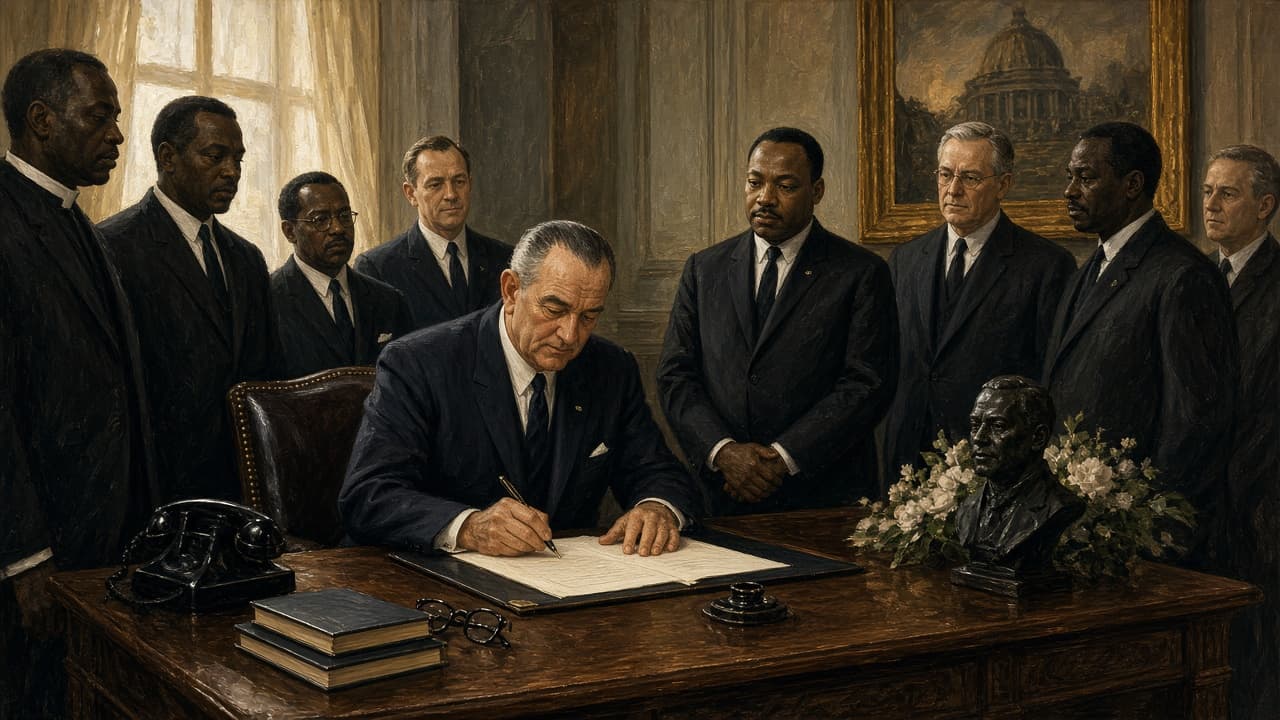
On 6 August 1965, Lyndon Johnson signed the Voting Rights Act in a room at the Capitol. It suspended literacy tests, sent federal examiners into the South and required covered states to clear new election rules in advance.
On 6 August 1965, President Lyndon Johnson signed the Voting Rights Act in the President's Room just off the Senate chamber at the United States Capitol. The setting was chosen on purpose. It was the room where Abraham Lincoln had signed a confiscation act in 1862 freeing enslaved people used in the Confederate war effort. Martin Luther King Jr., Rosa Parks, John Lewis and Ralph Abernathy were among those in the room. Johnson called the right to vote the most powerful instrument ever devised by man for breaking down injustice, then handed out pens. The law he signed is generally considered the most effective civil rights statute in American history.
The problem the act addressed was 95 years old. The Fifteenth Amendment, ratified in 1870, already said the right to vote could not be denied on account of race. Southern states spent the following decades building machinery to deny it anyway without saying so. Poll taxes priced out the poor. Literacy tests asked Black applicants to read and interpret arbitrary passages of the state constitution while white applicants were waved through. Grandfather clauses exempted anyone whose ancestors had voted before Reconstruction. White primaries made the only meaningful election a private club affair. Registrars kept short hours, lost forms and failed applicants for putting the wrong date format on a line. Behind all of it sat the threat of losing a job, a loan or a life.
The numbers show how completely it worked. By 1964, Black registration in Mississippi stood at roughly 6.7 percent of eligible adults, and in Alabama around 19 percent. In some counties with Black majorities, the figure was effectively zero. Earlier federal laws had tried to fix this case by case. The Civil Rights Acts of 1957, 1960 and 1964 let the Justice Department sue individual registrars, and the department did, county by county, for years. Each lawsuit took months, and a defeated county would simply invent a new obstacle. Attorney General Nicholas Katzenbach and his staff concluded that litigation could not outrun improvisation, and that only a law which moved the burden of proof would work.
Selma is what forced the issue into the open. Dallas County, Alabama, had a Black majority and about 2 percent Black registration, and the Student Nonviolent Coordinating Committee had been organising there since 1963. King's Southern Christian Leadership Conference joined in January 1965, deliberately choosing a place with a sheriff, Jim Clark, likely to react violently in front of cameras. On 18 February, state troopers shot a young deacon named Jimmie Lee Jackson in nearby Marion as he tried to protect his mother and grandfather. He died on 26 February. Activists proposed marching the 54 miles from Selma to the state capitol in Montgomery to put his death in front of Governor George Wallace.
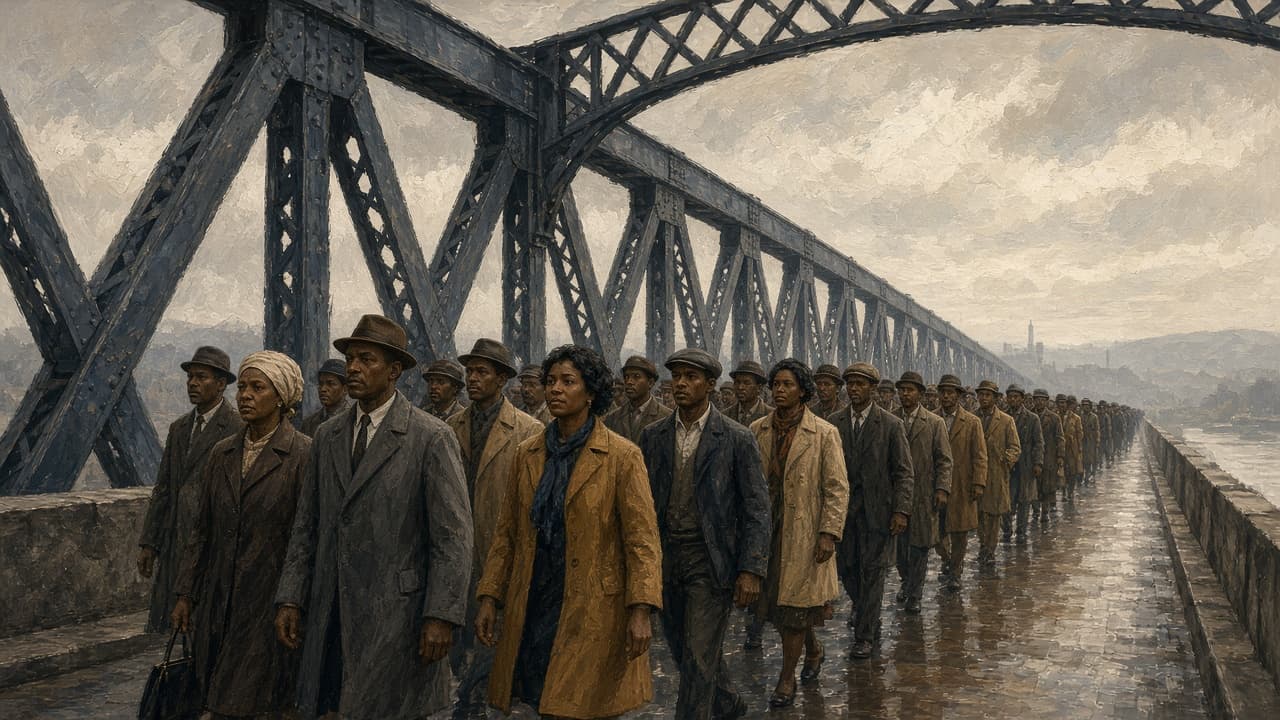
On Sunday 7 March 1965, about 600 marchers walked out of Selma and over the Edmund Pettus Bridge, where state troopers and mounted possemen met them with clubs, whips and tear gas. John Lewis, then 25, had his skull fractured. Amelia Boynton was beaten unconscious. ABC interrupted its Sunday film to broadcast the footage to tens of millions of homes, and the evening entered American memory as Bloody Sunday. Clergy of every denomination travelled to Selma within days. A white Unitarian minister from Boston, James Reeb, was beaten in the street on 9 March and died on 11 March. The march finally went the full distance from 21 to 25 March under federal court protection and National Guard escort. That night, Viola Liuzzo, a white volunteer from Detroit driving marchers home, was shot dead by Klansmen on Highway 80.
Johnson moved fast, and he did it in public. On 15 March he addressed a joint session of Congress in a televised speech widely rated among the best any president has delivered. He told the country that there is no Negro problem, no Southern problem, no Northern problem, only an American problem, and he closed by adopting the movement's own anthem, saying that we shall overcome. King reportedly wept watching it. The bill went to Congress two days later. Southern senators filibustered, as they had against every civil rights measure for decades, and cloture was invoked on 25 May. The Senate passed it 77 to 19 and the House 333 to 85, with Republican votes essential in both chambers.
The statute worked by changing who had to prove what. Section 2 banned any voting practice that denied the right to vote on racial grounds anywhere in the country. Section 4 suspended literacy tests and similar devices in jurisdictions caught by a coverage formula, which looked at whether a state or county had used such a test in November 1964 and had registration or turnout below 50 percent in the 1964 election. That formula initially covered Alabama, Georgia, Louisiana, Mississippi, South Carolina, Virginia and parts of North Carolina. Section 5 was the sharp edge. Covered jurisdictions could not change any election rule, from a literacy test to a polling place location or a district boundary, without first getting approval from the Justice Department or a federal court in Washington. Other sections sent federal examiners to register voters directly and observers to watch polls.
The effect was immediate in a way legislation rarely is. Federal examiners registered tens of thousands of voters within months. Black registration in Mississippi rose from under 7 percent in 1964 to nearly 60 percent by 1967, and comparable jumps happened across the covered states. The number of Black elected officials in the United States went from a few hundred in the mid-1960s into the thousands by the 1980s, first as sheriffs, school board members and county commissioners, then as mayors and members of Congress. John Lewis, whose skull was broken on the bridge, was elected to the House in 1986 and served until 2020. The 24th Amendment had already barred poll taxes in federal elections in 1964, and the Supreme Court struck them down for state elections in Harper v. Virginia Board of Elections in 1966.
Congress kept renewing it, and the Supreme Court eventually took the core out. The act was reauthorised in 1970, 1975, 1982 and 2006, the last time by 98 to 0 in the Senate and 390 to 33 in the House, for another 25 years. The 1975 renewal added protections for language minorities and required bilingual ballots in some areas. Then in 2013, in Shelby County v. Holder, the court ruled 5 to 4 that the coverage formula in Section 4 was unconstitutional because it rested on decades-old data. Section 5 preclearance survived on paper but had nothing to apply to, so it became inoperative overnight. Several states passed new voter identification requirements, cut early voting or closed polling places within weeks, some of which had previously been blocked under preclearance.
The fight has continued in the courts and stayed close. Brnovich v. Democratic National Committee in 2021 narrowed how Section 2 can be used to challenge voting rules. Allen v. Milligan in 2023 surprised many observers by upholding a Section 2 challenge to Alabama's congressional map and requiring a second majority-Black district. Bills to write a new coverage formula, usually named for John Lewis, have repeatedly passed the House and stalled in the Senate. Meanwhile the Edmund Pettus Bridge still carries the name of a Confederate general and Klan leader, and thousands of people walk across it every March in a commemoration that has become one of the few genuinely bipartisan pilgrimages in American politics.
Eagle Frame's takeaway: 6 August 1965 shows what a well-designed law can do and how fragile the design turns out to be. The act worked because it stopped asking victims to sue county by county and instead made suspect jurisdictions ask permission first. When the Supreme Court removed that requirement in 2013, the country found out how much of the progress had depended on it.