On this day: Voyager 1 launches
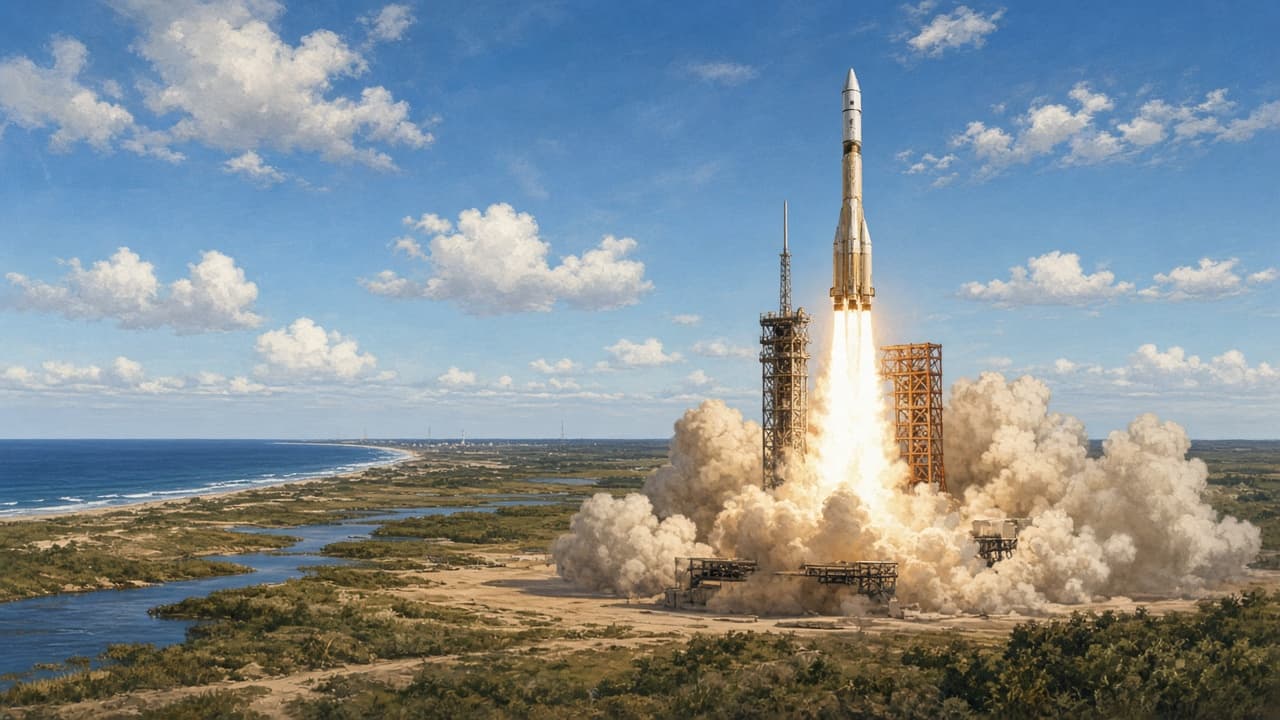
On 5 September 1977, NASA launched Voyager 1 from Cape Canaveral. The probe carried cameras, science instruments and a Golden Record on a grand tour path toward Jupiter, Saturn and eventually interstellar space.
On 5 September 1977, Voyager 1 lifted off from Cape Canaveral, Florida, aboard a Titan IIIE-Centaur rocket. NASA's mission was to send a durable robotic explorer past Jupiter and Saturn, using each planet's gravity as a slingshot. Voyager 2 had launched a few weeks earlier on a different path. Together they became humanity's farthest-traveling hardware and a symbol of curiosity aimed outward.
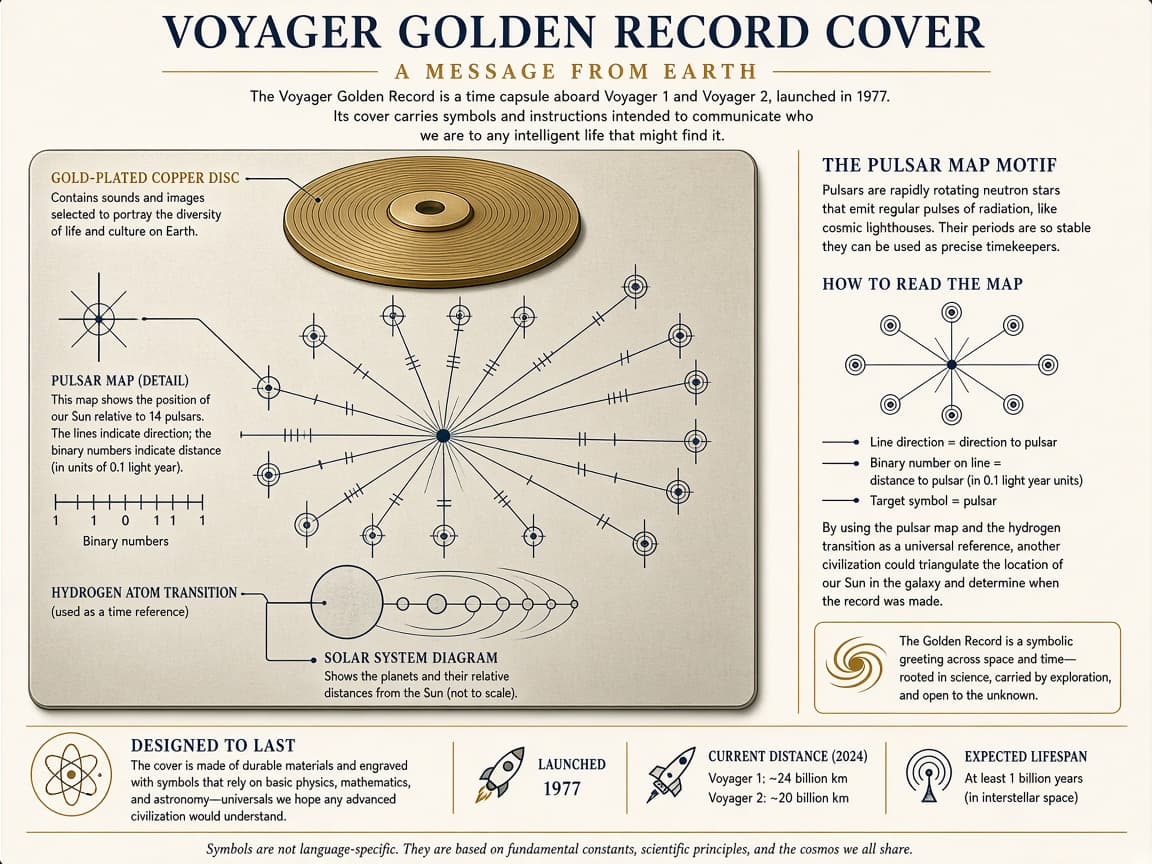
Voyager 1 carries a Golden Record whose cover includes instructions and a pulsar map meant to help any finder locate the Sun in the galaxy. Encoded audio and images sample Earth's cultures, languages and natural sounds. Carl Sagan's team designed it as a bottle in the cosmic ocean, not as a serious postal plan. The educational cover diagram reminds readers that the mission was science plus a deliberate message about who we thought we were in 1977. Trajectory designers chose a faster Jupiter-Saturn path that skipped the Uranus and Neptune legs.
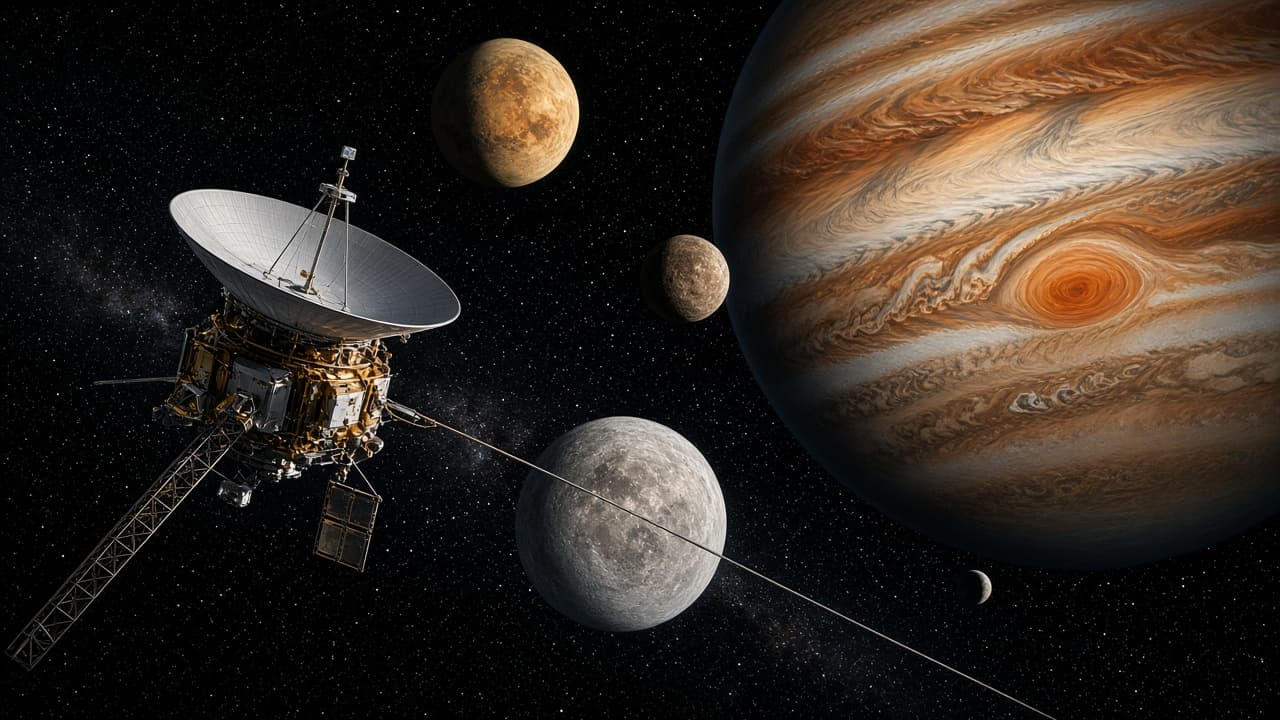
After launch, Voyager 1 raced to Jupiter and Saturn on a faster path than Voyager 2, delivering close looks at the giant planets and their moons before bending northward out of the ecliptic. Space art of the craft near Jupiter captures the payoff of that sprint: storm systems, rings and satellite surprises returned as data streams. Voyager 1 later became the farthest human-made object. The flyby image is the spectacular middle chapter between Cape Canaveral and interstellar quiet. Plasma and cosmic-ray instruments kept working long after the cameras' planetary tour ended.
What is a planetary flyby probe? It is an uncrewed spacecraft that passes a planet close enough to photograph and measure it, then continues on rather than orbiting forever. Chemical rockets of that era could not carry enough fuel to stop at every world. Gravity assist solves part of the energy problem: swing behind a moving planet and steal a bit of its orbital momentum to change your speed and direction.
Voyager 1's instruments included cameras, magnetometers, particle detectors and receivers for studying atmospheres and rings. At Jupiter in 1979 it returned detailed views of the Great Red Spot, volcanic Io and a complex system of moons. At Saturn in 1980 it studied the ring system and Titan's thick atmosphere. Each encounter was a one-time geometry problem: arrive on schedule or miss the science.
Both Voyagers carry a Golden Record: a gold-plated copper phonograph disc with music, greetings in many languages, natural sounds and images encoded as audio. A cover diagram shows how to play the record and from which star the craft came, using pulsar timing as a map. Carl Sagan and colleagues led the curation. The chance that anyone will ever find it is tiny. The point was also cultural: to say what Earth thought worth sending.
Power comes from radioisotope thermoelectric generators, which turn heat from decaying plutonium into electricity. Solar panels are too weak that far from the Sun. As the plutonium ages, power falls. Engineers have turned off instruments one by one to stretch the mission. Decades later Voyager 1 crossed into interstellar space, where the Sun's solar wind no longer dominates and still whispered data home on a faint radio link. Communication itself is a lesson. The Deep Space Network's large antennas on Earth catch signals measured in fractions of a watt by the time they arrive. Commands take hours to reach the craft at light speed. Troubleshooting a glitch means thinking ahead across that delay. Students who only know Wi-Fi at arm's length can use Voyager to feel what distance does to engineering. The 1977 launch window existed because the outer planets lined up in a way that repeats only every 175 years or so for a multiplanet grand tour. Mission designers seized the geometry. That is why two probes left in the same season with related but not identical itineraries. Opportunity and preparation shared a calendar.
Images of Jupiter's swirling storms and Saturn's rings changed textbooks. So did the later "Pale Blue Dot" portrait of Earth from afar, framed by Voyager's journey. The hardware is a 1970s computer flying through the dark. The science is ongoing proof that careful design can outlive the politics of any single budget year.
Voyager's computers were tiny by modern standards yet carefully hardened against radiation. Redundant systems and uplinkable software patches let engineers fix problems from Earth years into flight. When a receiver failed or a scan platform stuck, teams invented workarounds that became legend inside JPL. Longevity was designed and then continually earned.
Jupiter's radiation belts were a hazard as well as a science target. The spacecraft had to thread a path that gathered data without frying electronics. Saturn's rings posed collision risks for certain trajectories. Mission design was choreography under physics constraints, not a sightseeing whim.
Cultural freight traveled with the hardware. The Golden Record's music mixed Bach, Chuck Berry and folk traditions. Greetings tried to speak for Earth without pretending one language could. Whether or not aliens ever hear it, humans still use the record to argue about what we think we are.
Eagle Frame's takeaway: 5 September 1977 is when Voyager 1 left Earth on a gravity-assist tour that still speaks from interstellar space. Keep flybys versus orbiters in view, along with the Golden Record and the plutonium power supply. That is how a 1970s probe remains one of our best teachers of deep-space engineering.