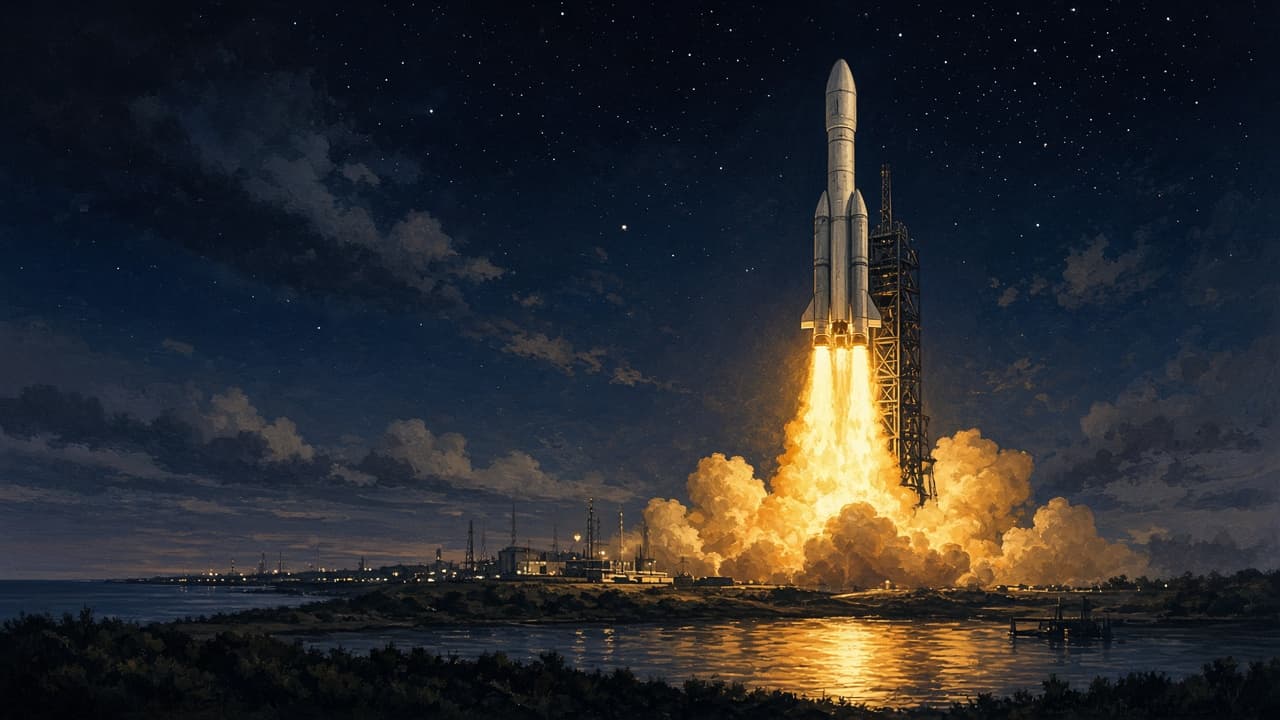
On this day: Voyager 2 launches
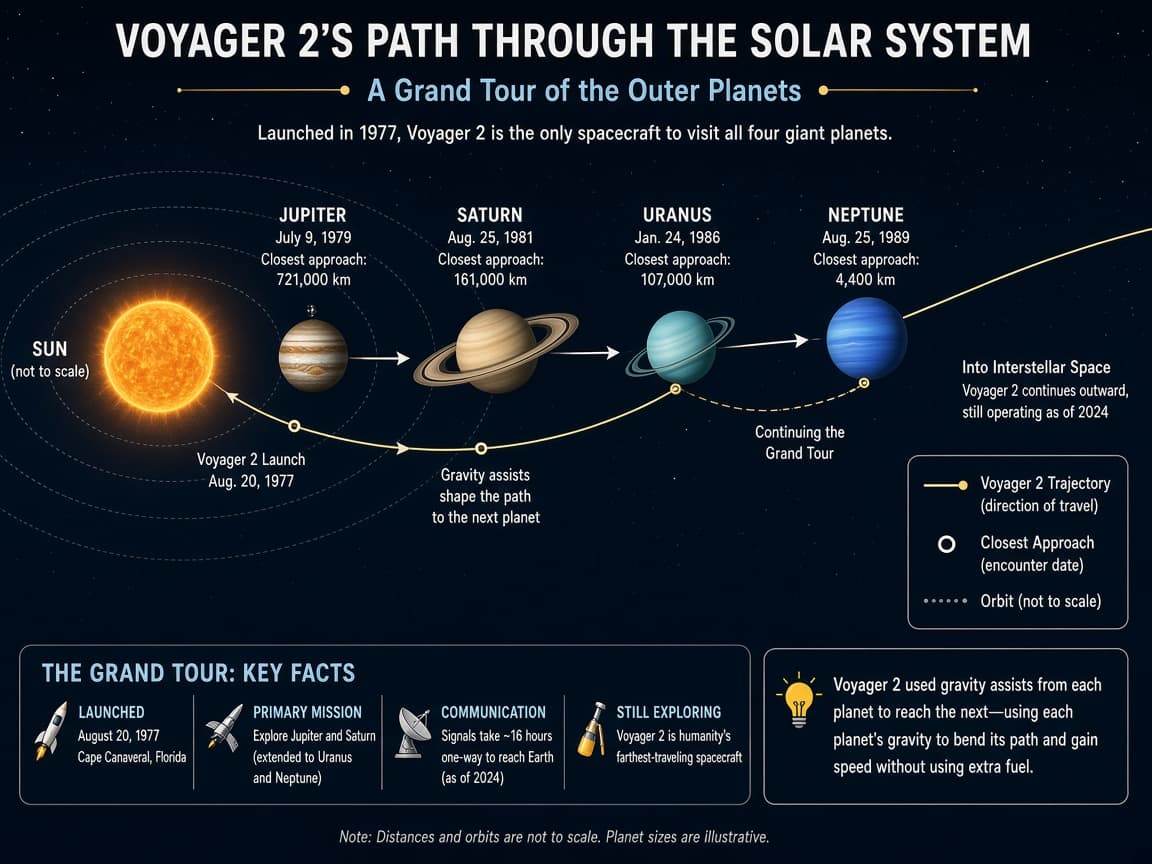
On 20 August 1977, NASA launched Voyager 2 from Cape Canaveral on a Grand Tour trajectory. The probe would visit Jupiter, Saturn, Uranus and Neptune using gravity assists.
On 20 August 1977, NASA launched Voyager 2 from Cape Canaveral on a Titan IIIE-Centaur rocket. The spacecraft left Earth on a path designed for a rare Grand Tour of the outer solar system. If all went well, it would fly past Jupiter and Saturn and, thanks to a once-in-175-years planetary alignment, continue to Uranus and Neptune. Voyager 1 launched sixteen days later on a faster trajectory aimed primarily at Jupiter and Saturn. Both probes carried identical science packages and a Golden Record of sounds and images from Earth.
How does a planetary probe travel so far on one launch? Rockets provide the first push, but fuel limits how much speed they can add. Gravity assist turns a planet's motion into a free boost. The spacecraft flies close enough that the planet's gravity bends its path and adds energy relative to the Sun. Mission designers chart a series of these flybys like banked curves on a cosmic racetrack. Each pass must be timed to the second; a miss of minutes can mean missing a world entirely.
Voyager 2's hardware diagram is a tour of deep-space necessities. A high-gain antenna keeps a thin radio link to Earth across billions of kilometers. Radioisotope thermoelectric generators convert heat from decaying plutonium into electricity when sunlight is too weak. Scan platforms aim cameras and spectrometers at fleeting flyby targets. Magnetometers and particle detectors sample invisible environments around giant planets. The spacecraft is a toolkit, not a single camera. Knowing those parts explains how one launch could rewrite textbooks at four different worlds years apart.
The Grand Tour path used gravity assists at Jupiter and Saturn to reach Uranus and Neptune on a schedule set by a rare planetary lineup. Each flyby bent and sped the trajectory so chemical fuel alone would never have finished the job. Mission planners accepted a one-way exit from the solar system's neighborhood afterward. Decades later Voyager 2 still returns faint data from interstellar space. The path diagram teaches celestial mechanics as career: patience, timing and ruthless mass budgets for a probe that cannot come home.
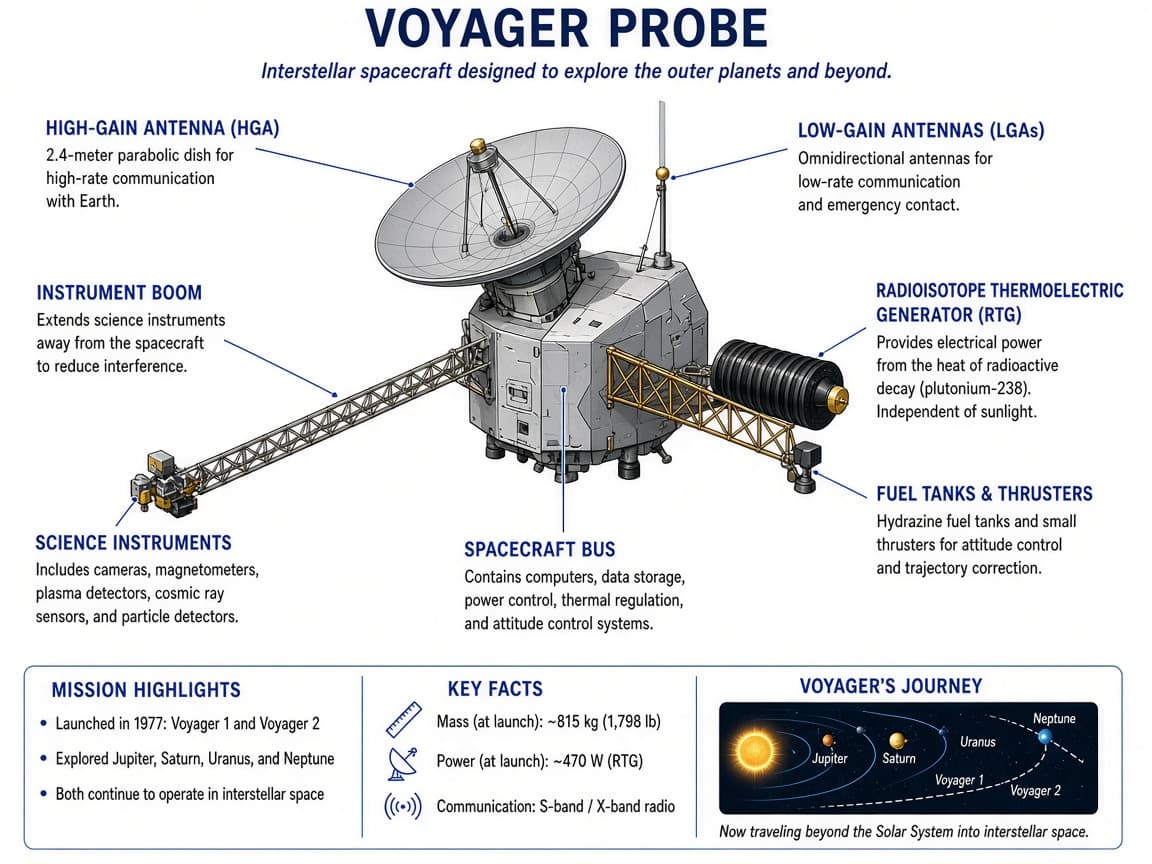
Voyager 2's instruments were built to work for years in deep cold and radiation. Cameras, magnetometers, spectrometers and particle detectors would study atmospheres, rings, magnetic fields and moons. Power came from radioisotope thermoelectric generators: plutonium decay produces heat converted to electricity. Sunlight is too weak past Jupiter for useful solar panels. The RTGs keep both Voyagers alive decades later, though power budgets shrink as the fuel ages.
The Grand Tour was not guaranteed when engineers started planning. Budget cuts once threatened to cancel the outer-planet legs. Scientists and public advocates fought to keep the four-planet option alive. The 1977 launches were the payoff: two identical machines with complementary trajectories so that if one failed at a critical maneuver, the other might still succeed. In practice both became legends.
Flyby results rewrote textbooks. At Jupiter, Voyager 2 joined Voyager 1 in revealing the Great Red Spot's complexity, active volcanoes on Io and intricate structure in Jupiter's rings. At Saturn, it studied the ring system and moon Titan before heading outward on the path only Voyager 2 could take. Uranus in 1986 showed a smooth-looking blue world tipped on its side. Neptune in 1989 displayed the Great Dark Spot and geysers on Triton. No other spacecraft has visited those ice giants since.
After Neptune, Voyager 2 kept going. In 2018 it crossed the heliopause, the boundary where the solar wind yields to interstellar space, joining Voyager 1 as an interstellar probe. Signals now take many hours to reach Earth. Engineers turn off instruments one by one to stretch power into the 2030s. The probe launched on 20 August 1977 may still be humanity's last close look at Uranus and Neptune for generations.
The Golden Record aboard each Voyager carries greetings in many languages, music from Bach to Chuck Berry, natural sounds and encoded images. Carl Sagan and a team assembled it as a message in a bottle for any civilization that might find the craft drifting between stars. Whether that find ever happens, the record states plainly that on one August day in 1977 a species built machines to leave its neighborhood and look back with cameras.
For readers who treat space news as only Mars rovers and billionaire rockets, Voyager 2 is the long baseline. It proves that careful gravity-assist math and rugged engineering can turn a single launch into a tour of four worlds. Schoolroom posters of the solar system still lean on Voyager colors and shapes. The probe is old enough to collect retirement metaphors and still transmitting.
Mission planners banked on a planetary alignment that opens only once in roughly 175 years. Missing the 1977 window would have delayed outer-planet visits by decades. That deadline focused budgets and testing schedules across NASA centers. The August launch was therefore not only a rocket event. It was the on-time departure for a bus route through the giant planets that physics would not schedule again for another lifetime.
Eagle Frame's takeaway: 20 August 1977 is Voyager 2's launch on a gravity-assist Grand Tour. Know the Titan-Centaur push, know how flybys steal speed from planets and know that this probe alone has sent close images of Uranus and Neptune back to Earth.