On this day: the Warsaw Uprising begins
At five in the afternoon on 1 August 1944, the Polish Home Army attacked German positions across Warsaw. The rising was planned to last a few days until the Red Army crossed the Vistula. It held out for 63 days and cost the city around 150,000 civilian lives.
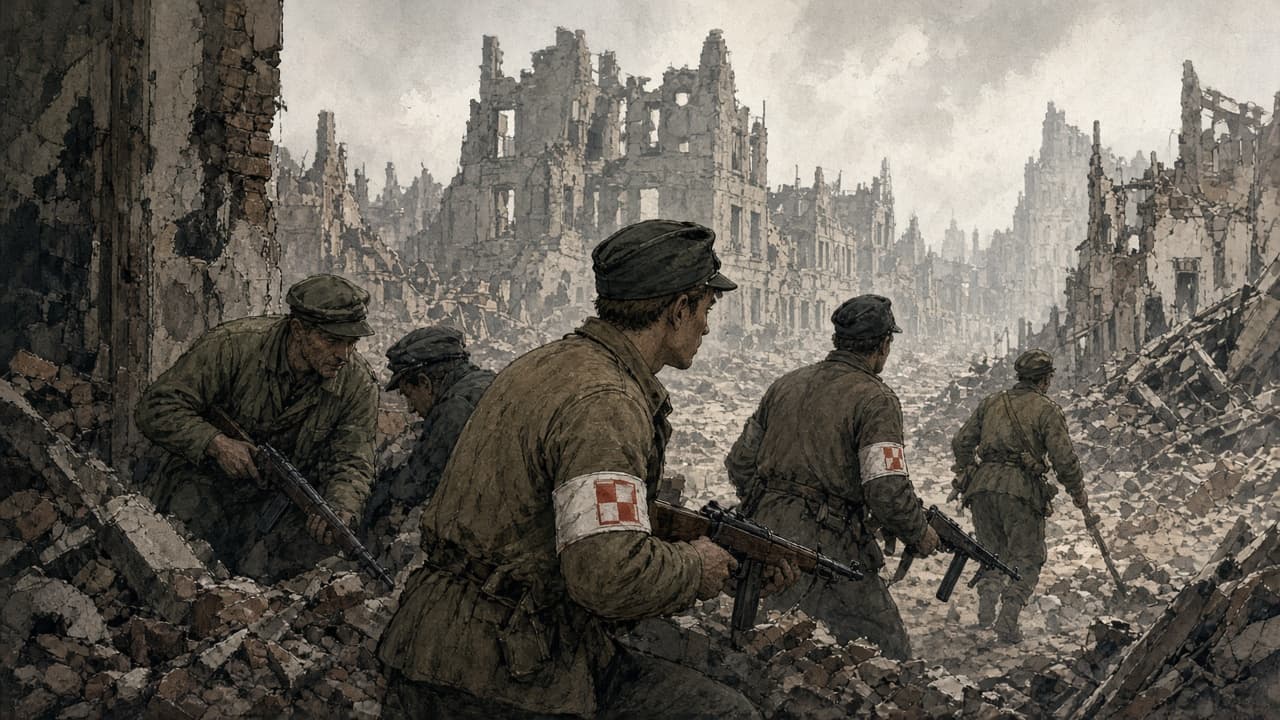
At five o'clock in the afternoon on 1 August 1944, thousands of young men and women across Warsaw pulled on white and red armbands and attacked German positions. The signal was known as godzina W, W-hour, the W standing for wybuch, outbreak. Trams stopped in the street. Rifles that had been buried in gardens and walled into cellars for years came out. The Polish Home Army put somewhere between 25,000 and 40,000 fighters onto the streets that afternoon and roughly one in ten of them had a firearm. The plan assumed three or four days of fighting before the Red Army crossed the Vistula. The rising lasted 63 days.
Warsaw had been under German occupation for nearly five years by then. The city fell in September 1939 and the years since had brought street round-ups known as lapanki, in which people were seized off pavements for forced labour, mass executions in the Palmiry forest, torture at the Pawiak prison and a ban on secondary and university education that Poles answered by running schools and lecture courses in flats. The prewar population of about 1.3 million included roughly 350,000 Jews.
This was not the Warsaw Ghetto Uprising, and the two are confused constantly. In April and May 1943, fighters of the Jewish Combat Organization under Mordechai Anielewicz resisted the final deportation of the ghetto with pistols and homemade bombs, held out for close to a month and were destroyed along with the district, which the Germans then flattened deliberately. By August 1944 that part of Warsaw was an empty field of rubble and around 300,000 of the city's Jews had been murdered, most of them at Treblinka. The 1944 rising was a different event, by a different organization, in a city that had already lost a quarter of its people.
The Home Army, Armia Krajowa, reported to the Polish government in exile in London. By 1944 it had something like 300,000 to 400,000 sworn members and was the largest organized resistance movement in occupied Europe. Behind it stood an entire underground state with courts, tax collection, clandestine universities, a welfare apparatus and a press that printed hundreds of titles. Warsaw also held units of the communist People's Army and of the nationalist National Armed Forces, and some of them fought alongside the Home Army once the shooting started.
The reason for rising at all was political as much as military. Home Army strategy, code-named Tempest, had units seize towns just ahead of the retreating Germans so that Polish authorities could greet the Soviets as hosts rather than as suppliants. In Wilno and Lwow it worked in the field and then the Soviets arrested the Polish officers who had helped them. Stalin had broken off relations with the London government in 1943, after the discovery of the graves at Katyn where the Soviet secret police had shot around 22,000 Polish officers and officials in 1940. On 22 July 1944 Moscow installed its own Polish Committee of National Liberation at Lublin. If the Red Army took Warsaw, that committee would run it. If Poles took Warsaw first, the legal government might still have a claim.
The order came in a hurry. By 31 July Soviet tanks were reported at Radzymin and Wolomin, a short drive east of the city, and Soviet radio had been broadcasting appeals for Warsaw to rise. That evening General Tadeusz Bor-Komorowski gave the order and Colonel Antoni Chrusciel, known by the cover name Monter, set W-hour for the following afternoon. The inventory was about a thousand rifles, a few hundred machine pistols, a handful of anti-tank weapons and thousands of grenades, many of them produced in underground workshops. The Home Army even manufactured its own submachine gun, the Blyskawica, in a Warsaw flat.
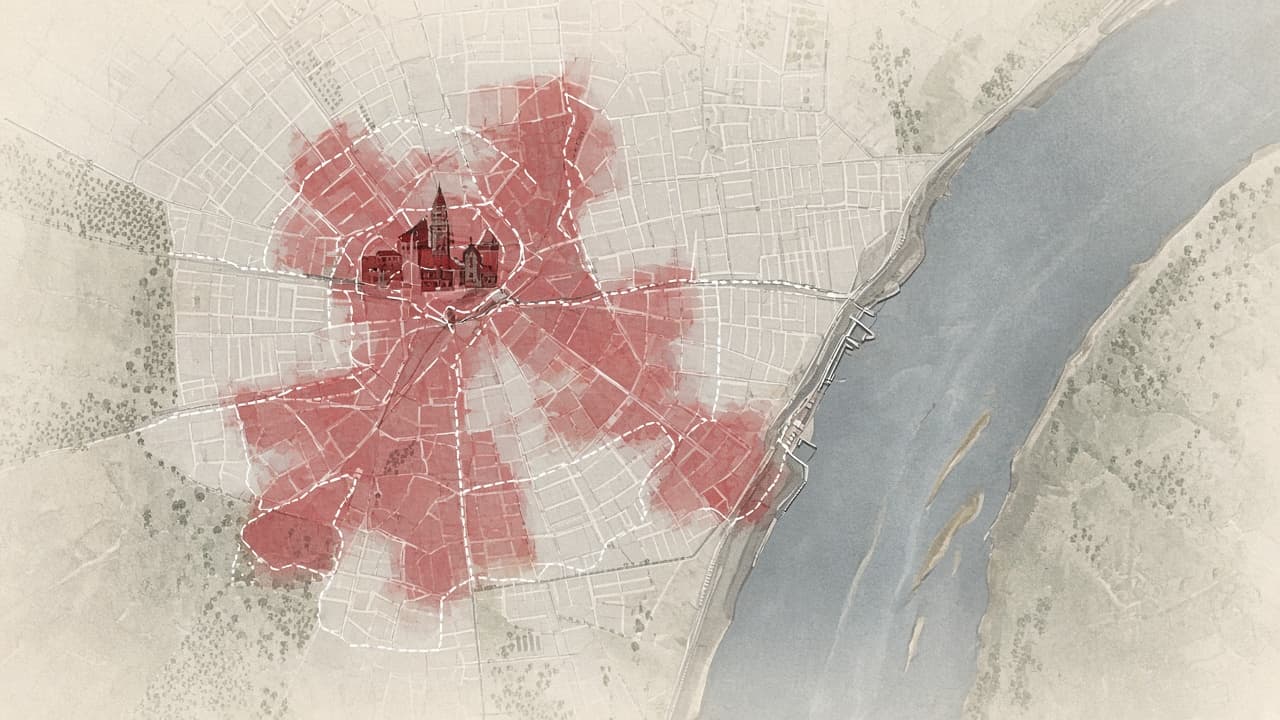
The first hours went better than the arsenal suggested. Insurgents took much of the city centre, the Old Town, Wola, Zoliborz, Mokotow and Powisle, cut German communications and raised the Polish flag over the tallest building in the city for the first time since 1939. They failed at the objectives that mattered most. The Vistula bridges held. So did the airfield at Okecie, the citadel, the main barracks and the telephone exchange. Because no airfield was captured, nothing heavy could be flown in. Because no bridge was held, there was no way to link up with the east bank. The rising was therefore dependent from day one on an army it had never coordinated with.
The German response was not a counterattack in the normal sense. Heinrich Himmler treated the rising as a chance to settle Warsaw permanently, and the order was that the city be destroyed and its inhabitants killed. SS General Erich von dem Bach-Zelewski took command with formations including the Dirlewanger brigade, assembled from convicts, and a unit of Russian collaborators. Between 5 and 7 August they cleared the western district of Wola house by house and shot the people inside, including the patients and staff of two hospitals. Estimates of the dead in those three days commonly run from 30,000 to 40,000. Ochota suffered comparably. These were not battle casualties.
What followed was nine weeks of close fighting through cellars, courtyards and roofs. The sewers became highways, and couriers, many of them teenage girls, moved for hours at a time through waist-deep filth carrying orders and ammunition between districts. Insurgents fought tanks with petrol bottles and captured anti-tank launchers. The Germans, facing no air opposition at all, used dive bombers, a 600 mm siege mortar and remote-controlled demolition charges that were driven into barricades and detonated. The Old Town held for a month and was abandoned in the night of 1-2 September, its surviving fighters crawling out through a sewer to the city centre while wounded who could not be moved were left behind and killed. The poet Krzysztof Kamil Baczynski, aged 23, was shot by a sniper on 4 August. Food ran short, then water.
Supply had to come from Italy. Polish, British, South African and other Commonwealth crews flew round trips of roughly 1,400 kilometres each way from Brindisi, dropping containers onto a burning city at low level, and dozens of aircraft and around 200 airmen were lost doing it. Stalin refused to let Allied aircraft land or refuel on Soviet airfields until September, and described the insurgents to Western envoys as a handful of criminals. Permission came late. On 18 September 107 American B-17s made a daylight drop of more than 1,200 containers, and most of them drifted into German-held ground. The Red Army took the Praga district on the east bank on 14 September and stopped. Between 15 and 23 September, Polish units under Soviet command attempted crossings of the Vistula and were cut apart on the far bank.
Bor-Komorowski's negotiators signed the capitulation in the night of 2-3 October at Ozarow, west of the city. The terms were unusual: the Germans agreed to treat Home Army fighters as prisoners of war under the Geneva Convention rather than as bandits, which is why roughly 15,000 of them went into camps instead of being shot. Bor-Komorowski himself ended the war in German captivity. Around 16,000 insurgents were killed. Civilian deaths are usually estimated at 150,000 to 180,000. German losses are disputed and figures between 8,000 and 17,000 are cited.
Then came the part Hitler had ordered in August. About half a million surviving residents were marched out of Warsaw through a transit camp at Pruszkow, from where some went to concentration camps, many to forced labour in Germany and the rest were dispersed into the countryside. Demolition squads then worked through the empty streets with flamethrowers and explosives, burning the Royal Castle, the national library collections, the archives and most of the churches as a matter of policy rather than combat. By the time Soviet and Polish troops walked in on 17 January 1945, something close to 85 per cent of the left-bank city was rubble.
The postwar Polish state then punished the survivors. Home Army veterans were interrogated, imprisoned and in some cases executed as enemies of the new order. General Emil Fieldorf, a deputy commander known by the cover name Nil, was hanged in 1953 after a show trial. Honest public commemoration was not possible until 1989. The Warsaw Rising Museum opened on the sixtieth anniversary in 2004 and is now one of the most visited museums in Poland. Every 1 August at five in the afternoon the sirens sound across the city and people stop where they are standing.
Whether it should have happened has been argued in Poland for eighty years. The case against is direct: the Home Army attacked a German army group with pistols and grenades while relying on a Soviet advance that had never been agreed, and the city and its civilians paid for the gamble. The case for is also direct: the alternative was to watch a Soviet-appointed committee take the capital while Poland's own army stood still, and the men who gave the order were reasoning about the survival of a country that had already been partitioned twice inside five years. Both arguments are made by people who were in the cellars.
Eagle Frame's takeaway: 1 August 1944 is the day Warsaw's underground army rose against one occupier partly in order to have something to show the next one, and then held out for nine weeks with about one gun for every ten fighters. Keep it separate from the Ghetto Uprising of 1943, note that the Red Army stopped on the far bank of the Vistula, and remember that the city was demolished afterwards as a punishment.