
On this day: the Western Roman Empire ends in Italy
On 4 September 476, Odoacer deposed the young emperor Romulus Augustulus in Italy. Historians traditionally treat the date as the end of the Western Roman Empire, while the Eastern Empire in Constantinople continued.
On 4 September 476, the Germanic commander Odoacer forced the young emperor Romulus Augustulus from power in Italy. Romulus was not killed. He was pensioned off to a villa in Campania. In Ravenna, then the western imperial residence, the line of Western Roman emperors stopped. Later writers treated that deposition as the traditional end of the Western Roman Empire. The date is a teaching marker, not a light switch that turned Roman civilization off overnight.
Romulus Augustulus was probably still a teenager. His father, Orestes, a Roman military official, had placed him on the throne in 475 after driving out the previous emperor, Julius Nepos. The nickname Augustulus, little Augustus, stuck because of his youth. He never controlled the old empire's full machinery. By the 470s the Western court held Italy and fragments of authority, while much of Gaul, Spain, North Africa and Britain had already passed into the hands of Gothic, Vandal, Frankish and other kingdoms that were themselves entangled with Roman institutions. Coins, titles and church structures often outlived the emperors who had once appointed governors to those lands.
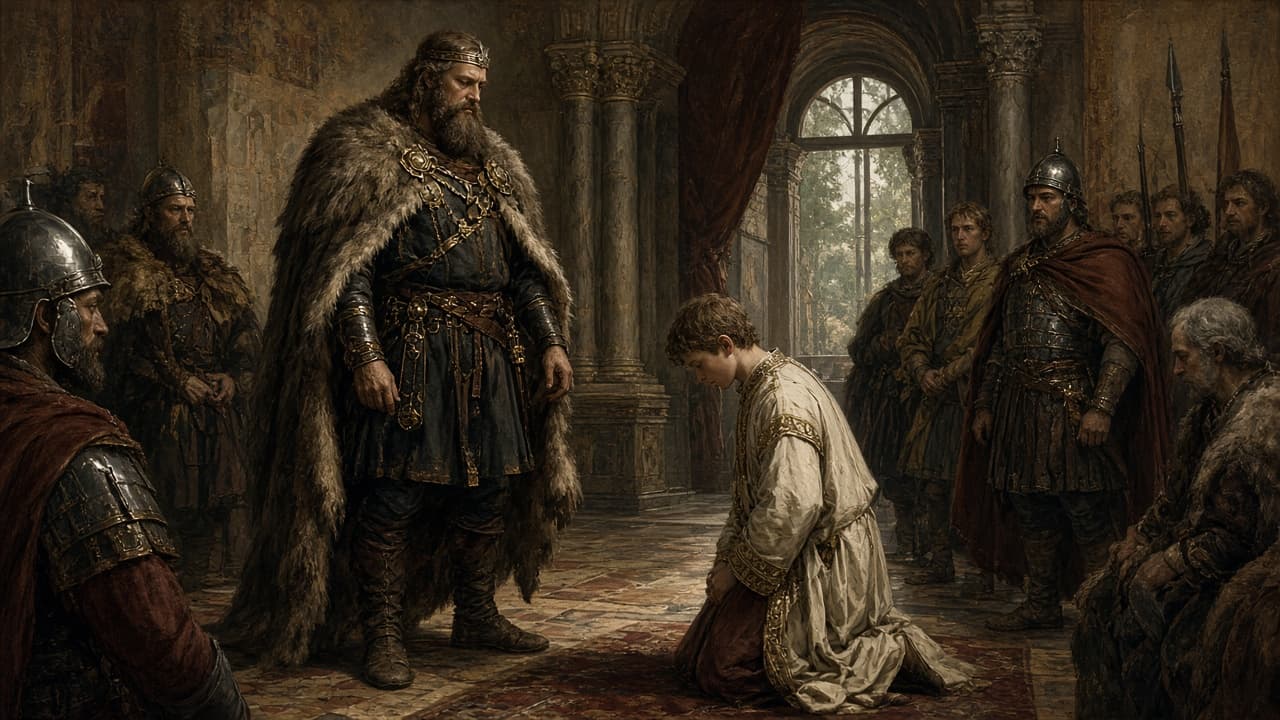
Odoacer led foederati troops, allied soldiers settled in Italy who demanded land grants. When Orestes refused their demands, they revolted. Orestes was captured and killed. Odoacer then removed Romulus and took power in Italy with the title of king rather than emperor. He sent the Western imperial insignia to Constantinople and presented himself as ruling Italy under the authority of the Eastern emperor. That gesture matters. Even the man who ended the Western imperial line framed his rule inside a Roman hierarchy centered on the East. He was dismantling a court, not announcing that Rome as an idea had vanished.
The Eastern Roman Empire, often called the Byzantine Empire by later historians, did not fall in 476. It kept emperors in Constantinople, a working tax system, armies, law courts and cities for centuries afterward. Justinian in the sixth century even tried to reconquer parts of the West, temporarily retaking North Africa and Italy at huge cost. Greek language and Christian institutions shaped Eastern Roman life, but the state understood itself as Roman. Any account of 476 that says Rome fell and leaves out Constantinople is incomplete. The map of power shifted. The name did not disappear. That single fact should sit beside every Western end-date in a school timeline.
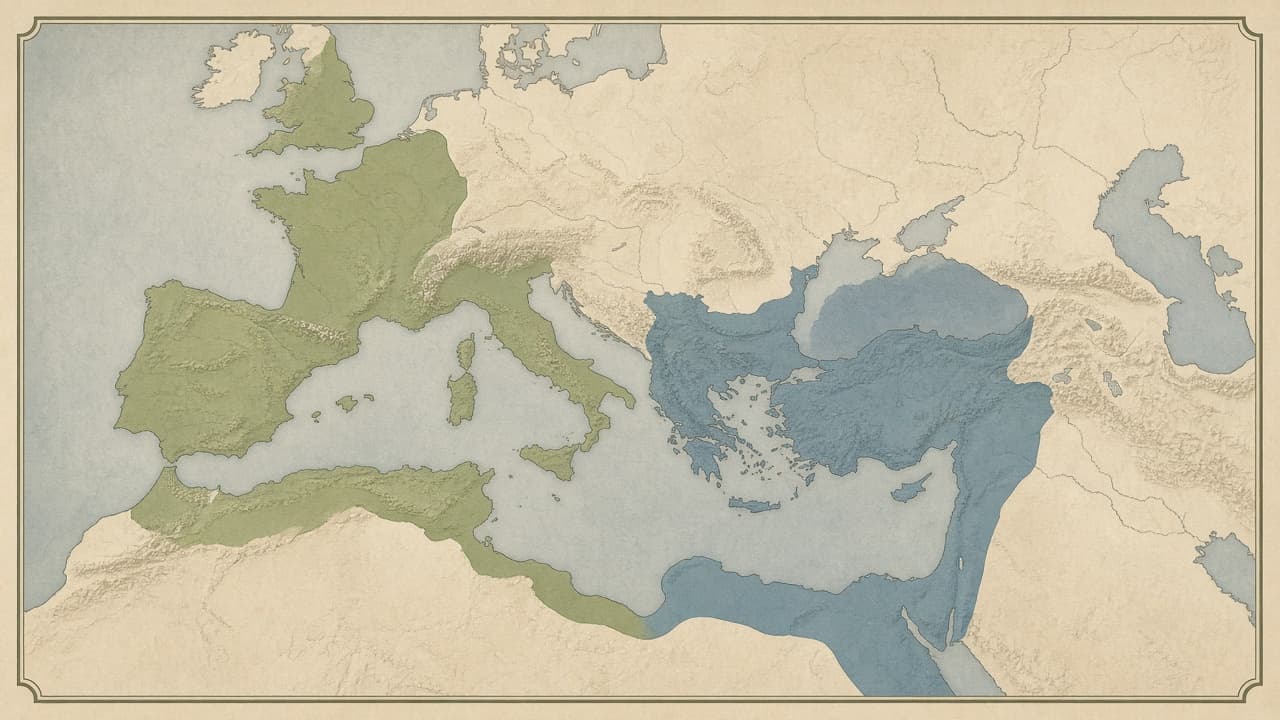
Why do textbooks still highlight 476? Because it is a convenient boundary for a long process. Over the fifth century Western emperors lost provinces, tax revenue and military monopoly. Germanic kingdoms used Roman titles, coins and bishops while building their own power. The deposition of Romulus was dramatic and easy to date. Historians have long used it as a traditional marker for the end of imperial rule in the West, while arguing about what continuity remained in law, language, landholding and the Church. A single calendar day is easier to teach than a hundred years of negotiation between courts and armies.
The phrase Dark Ages is a contested label and should be handled carefully. Older European writing used it to describe the centuries after Rome as a collapse into ignorance. Modern historians reject that as a blanket judgment. Literacy, trade and urban life changed unevenly across regions. Monasteries copied books. Kingdoms issued laws. Constantinople remained a major city. Some areas saw real decline in population and complex building. Others reinvented Roman forms under new rulers. Saying 476 ends the Western Empire is not the same as saying Europe went dark. Precision beats nostalgia here.
Julius Nepos, the emperor Orestes had expelled, was still alive in Dalmatia and still claimed the Western title until he was murdered in 480. Some scholars therefore prefer 480 as a cleaner end point for Western imperial claims. Others stress 476 because Italy, the symbolic core, passed to a king who declined the purple. The argument itself shows the point: political endings in late antiquity were messy. Later historians chose dates to organize the mess for readers who need a chapter break.
For ordinary people in Italy, 476 did not erase Roman roads, estates or tax habits overnight. Odoacer's government still needed grain, soldiers and cooperation from Roman elites. The Senate in Rome continued in a reduced form. Latin remained the language of law and liturgy in the West. What changed at the top was the absence of a Western emperor and the rise of kings who negotiated with Constantinople instead of sharing a dual imperial college as in earlier centuries. Daily life bent slowly. Political letterhead changed faster.
Later memory loaded the date with meaning it could not carry alone. Renaissance and Enlightenment writers looking for a fall of Rome needed a climax. Nineteenth-century nation stories needed origins after empire. Twenty-first-century teaching still needs a handle for students. 476 works as a handle if teachers also say what continued: Eastern imperial power, Christian institutions, Roman law's afterlife and the hybrid kingdoms of the West. The useful classroom sentence is that the Western imperial office ended in Italy while Roman forms and the Eastern Empire kept going. Readers who want the politics without the myth should keep Odoacer, Romulus and Constantinople in the same paragraph.
Eagle Frame's takeaway: 4 September 476 marks Odoacer's deposition of Romulus Augustulus and the traditional end of the Western Roman Empire. The Eastern Empire continued from Constantinople. Dark Ages is too blunt a label for what followed. Use 476 as a marker while keeping the continuity debates in view.