On this day: Microsoft releases Windows 10
On 29 July 2015, Microsoft released Windows 10 as a free upgrade for most Windows 7 and 8.1 users. It brought back the Start menu, abandoned the numbered release cycle and eventually ran on more than a billion devices.
Windows 10 reached general availability on 29 July 2015. Microsoft gave it away, free, to anyone running a licensed copy of Windows 7 or Windows 8.1, for a year. That had never happened with a Windows release and it tells you how badly the previous version had gone. About 14 million devices installed it in the first 24 hours and roughly 75 million in the first month, the fastest adoption of any Windows version to that point, helped considerably by the price.
An operating system is worth defining before going further, because most people use one daily without a clear picture of what it does. It is the layer of software that sits between the hardware and everything you actually want to run. At its centre is the kernel, which decides which programme gets processor time, hands out blocks of memory, keeps applications from reading each other's data and speaks to devices through drivers. Around the kernel sit the file system, the networking stack, the security model and the graphical shell, which is the desktop, taskbar and windows you can see. Windows 10 sat on the NT kernel, a lineage that began with Windows NT 3.1 in 1993 and still underpins Windows today.
Windows 8, released in 2012, is the reason Windows 10 exists in the form it does. Microsoft had watched the iPad arrive and concluded that touch was the future of personal computing, so it redesigned the interface around full-screen tiles and deleted the Start menu that had anchored the desktop since Windows 95. On a tablet it made a kind of sense. On the hundreds of millions of desktop machines with a mouse and no touchscreen it was disorienting, and corporate customers simply refused to deploy it. Windows 8.1 restored a Start button in 2013 that only took you back to the tile screen, which satisfied nobody.
The response shaped the next release. Microsoft skipped the number 9 entirely, announcing Windows 10 in September 2014 to signal a break rather than an increment. The Start menu returned in a hybrid form, a conventional list of applications on the left with resizable tiles on the right, so both audiences got something recognisable. Tablet mode, marketed as Continuum, switched the interface automatically when a keyboard was detached from a convertible laptop. The company also opened the Windows Insider Programme in October 2014, letting millions of volunteers run pre-release builds and send telemetry and feedback, which was a real change in how a company that size developed a consumer product.
The features that shipped on launch day set the direction for the following decade. Cortana, the voice assistant from Windows Phone, came to the desktop with search built into the taskbar. Microsoft Edge replaced Internet Explorer as the default browser, ending a twenty-year run. Task View added virtual desktops, letting one machine hold several separate arrangements of windows. Windows Hello introduced sign-in by fingerprint or face using infrared cameras rather than passwords. DirectX 12 gave games lower-level access to graphics hardware and reduced the processor overhead of drawing a frame.
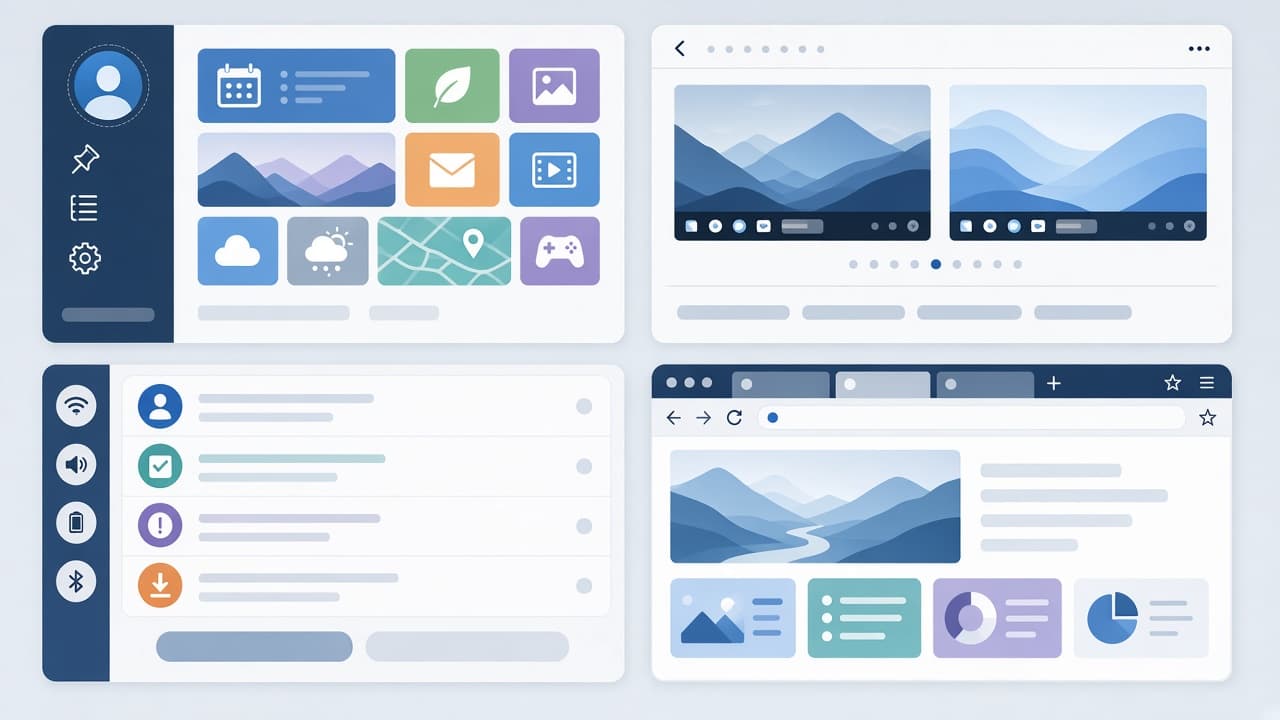
Underneath sat a more ambitious plan called OneCore. The idea was a single operating system core running on desktops, tablets, phones, the Xbox One and the HoloLens headset, with a Universal Windows Platform on top so a developer could write one application that ran on all of them, adapting its layout to the screen. Technically it largely worked. Commercially the phone half collapsed, because Windows Phone never gathered enough users for developers to bother, and Microsoft wrote down its Nokia acquisition and withdrew. The universal apps survived in a reduced form, and the shared core is still the reason Windows runs on an Xbox.
The bigger shift was in how updates worked. Microsoft called it Windows as a service. Instead of a large paid release every three or four years, Windows 10 would receive feature updates twice a year and security patches continuously, delivered automatically. A developer evangelist told a conference in 2015 that Windows 10 would be the last version of Windows, a line the company never formally endorsed but never corrected either, and it was widely believed for six years.
The complaints were real and mostly concerned control. Home edition users could not defer updates, which meant machines restarted on Microsoft's schedule and occasionally shipped a bad driver to millions of computers at once. Privacy advocates objected to the volume of diagnostic telemetry sent back by default and to how much of it could not be switched off. Worst of the lot was the Get Windows 10 upgrade prompt, which nagged users for months and at one point was reconfigured so that clicking the X to close the window scheduled the upgrade rather than cancelling it. A California travel agent, Teri Goldstein, won 10,000 dollars in small claims court in 2016 after an unwanted upgrade disrupted her business, and Microsoft changed the dialogue shortly afterwards.
The targets were missed and then met late. Microsoft had said publicly that Windows 10 would reach a billion devices within two or three years, which depended on the phone business that never materialised. It passed a billion monthly active devices in March 2020, about five years in. Windows 11 arrived on 5 October 2021, ending the last version of Windows idea, and its requirement for a TPM 2.0 security chip left a large number of otherwise serviceable machines unable to upgrade. Microsoft ended free support for Windows 10 on 14 October 2025 and offered extended security updates for a limited period after that, which set off a familiar round of arguments about working computers being pushed towards landfill.
Eagle Frame's takeaway: 29 July 2015 was a correction, not a leap. Microsoft gave the operating system away to undo the damage of Windows 8, restored the Start menu, replaced big paid releases with continuous updates and in doing so traded a lot of user control for a platform it could keep changing after installation.