On this day: Austria-Hungary declares war on Serbia
On 28 July 1914, Austria-Hungary declared war on Serbia, one month after the assassination of Archduke Franz Ferdinand in Sarajevo. Within a week the alliance system pulled Russia, Germany, France and Britain into the First World War.
On 28 July 1914, Austria-Hungary declared war on Serbia. The declaration arrived in Belgrade by telegram, which was itself a small sign of how fast the summer had moved. It was the first formal declaration of the conflict that became the First World War. Nobody signing it expected four years of trench lines from the North Sea to Switzerland, or roughly 17 million dead across armies and civilian populations. Most planners in Vienna thought they were starting a short punitive campaign against a small neighbor.
Start with the killing that set the clock running. On 28 June 1914, Archduke Franz Ferdinand, heir to the Austro-Hungarian throne, was shot in Sarajevo along with his wife Sophie. The gunman was Gavrilo Princip, a 19-year-old Bosnian Serb linked to a group that wanted South Slav lands out of Habsburg rule. Weapons and training had come through contacts in Serbian military intelligence, which is why Vienna treated the murder as a state problem rather than a police matter.
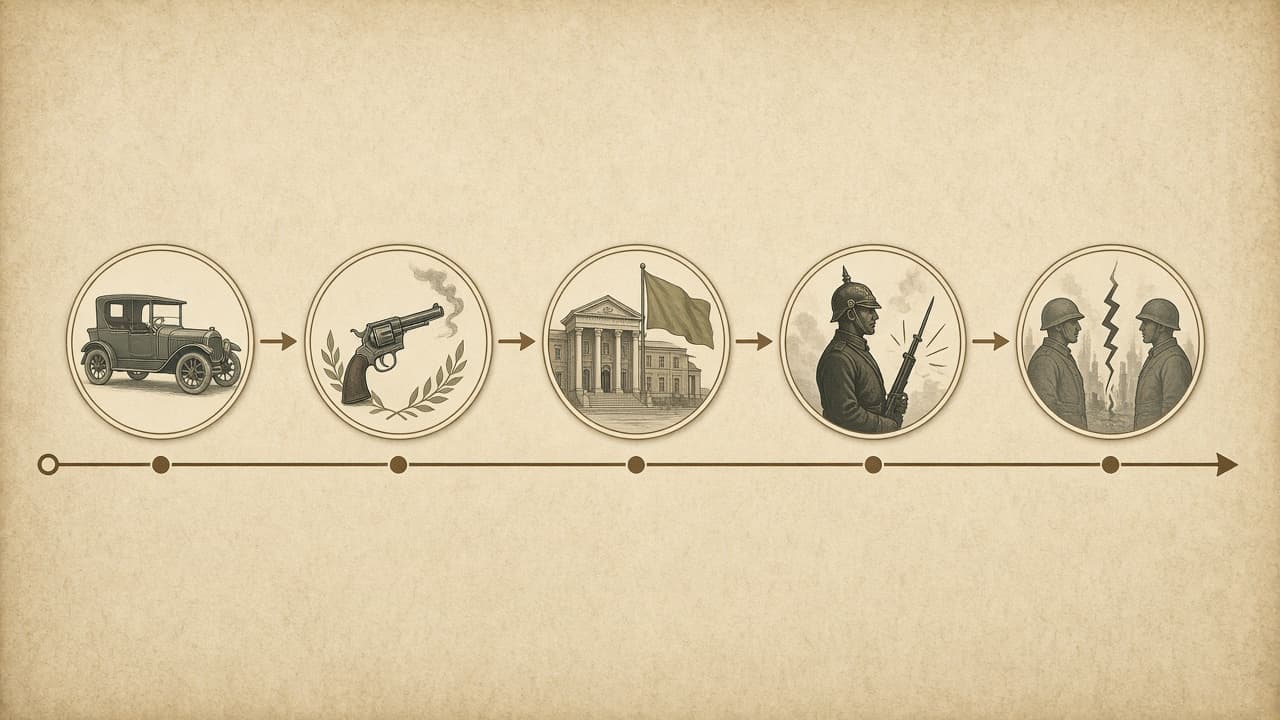
For four weeks Vienna did very little in public and a great deal in private. The key step was a trip to Berlin. German leaders gave Austria-Hungary what historians call the blank cheque, an assurance of support whatever Vienna decided to do about Serbia. That promise mattered because it removed the main reason for caution. Serbia had a protector in Russia, and Russia had a partner in France. Austria-Hungary would only risk a wider war if Germany stood behind it. Germany said it would.
On 23 July, Austria-Hungary handed Serbia an ultimatum with a 48-hour deadline. It demanded the suppression of anti-Habsburg groups, the removal of officials and teachers named by Vienna and, crucially, the participation of Austro-Hungarian officials in the investigation on Serbian soil. That last point was written to be refused. Serbia's reply on 25 July accepted almost everything and hedged on the sovereignty clause. Austria-Hungary broke relations the same evening. Even the German Kaiser read the Serbian reply and thought the grounds for war had mostly disappeared. Vienna disagreed.
Three days later the declaration went out, and Austro-Hungarian gunboats shelled Belgrade on 29 July. Belgrade sat on the Danube frontier, so the capital was within range of the first shots. What turned a Balkan war into a European one was mobilization. Russia began moving toward general mobilization to protect Serbia. German war planning assumed that if Russia mobilized, Germany had to strike France first and fast, because Germany could not fight a long war on two fronts. Timetables became policy.
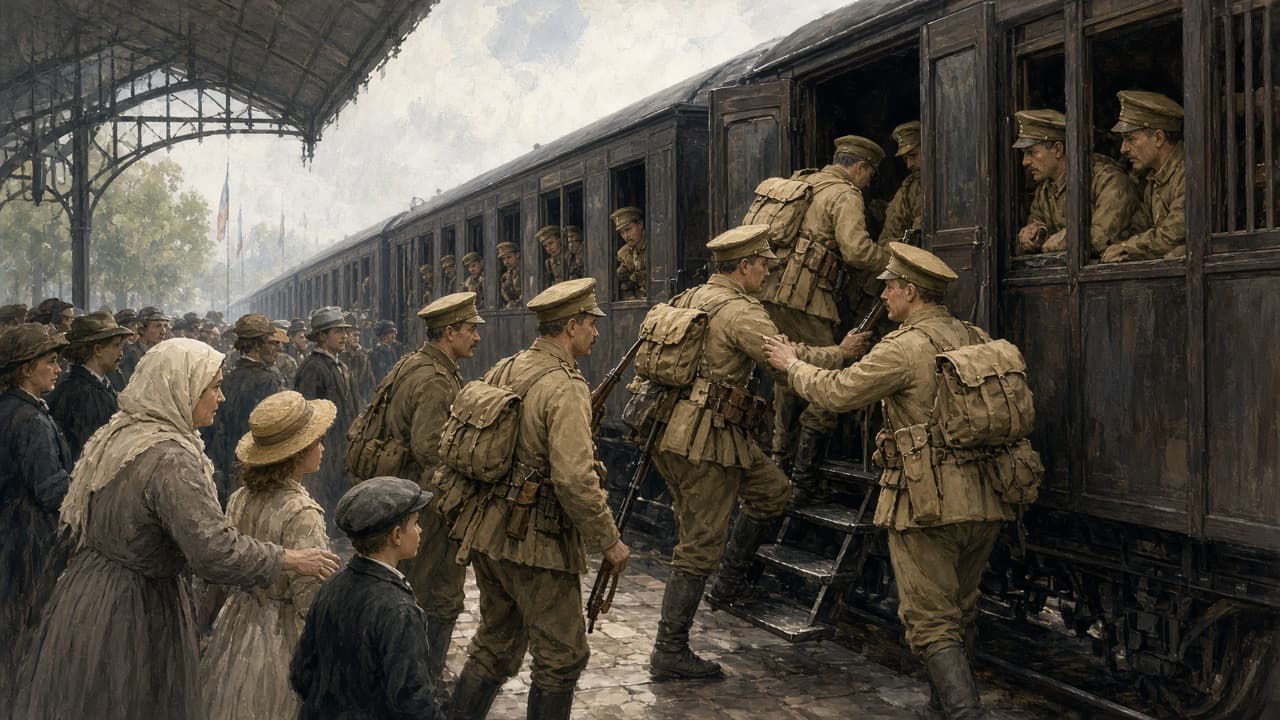
The cascade then ran in days. Germany declared war on Russia on 1 August and on France on 3 August. German troops crossed into Belgium to reach France by the shortest route, which violated Belgian neutrality guaranteed by an 1839 treaty. Britain declared war on Germany on 4 August. Within a week of the Serbian declaration, five great powers were at war. The Ottoman Empire joined the Central Powers later that year. Italy, nominally allied to Vienna and Berlin, stayed out and then joined the other side in 1915.
It helps to know why the alliances were so rigid. Europe had spent decades building paired guarantees: Germany with Austria-Hungary, France with Russia, Britain loosely attached to France through naval and colonial understandings. Each pact was sold at home as insurance against war. Combined, they meant a quarrel between Vienna and Belgrade could not stay local. Add mass conscript armies, dense rail networks and staff plans that measured advantage in hours, and the machinery rewarded whoever moved first.
Austria-Hungary itself was the least stable of the great powers, which is part of why it acted so hard. It was a multinational empire of Germans, Hungarians, Czechs, Poles, Croats, Serbs, Romanians and others held together by a dynasty rather than a nation. Serbian nationalism next door looked like a solvent. Vienna wanted a short war to prove the empire could still discipline its neighborhood. The war it got dissolved the empire entirely by November 1918.
Blame has been argued over for more than a century. Early treaty language pinned responsibility on Germany. Later historians spread it: Vienna chose war on thin evidence, Berlin encouraged it, Russia mobilized quickly, France did little to restrain its ally and Britain sent mixed signals about whether it would fight. The useful reading is not a single villain but a system in which several governments accepted the risk of a general war because each believed the alternative was losing standing.
For Serbia the cost was immediate and enormous. Serbian forces held off the first Austro-Hungarian offensives in 1914 and then collapsed under a combined German, Austro-Hungarian and Bulgarian attack in 1915. The army retreated across Albanian mountains in winter. Serbia lost a larger share of its population than any other combatant country, by most estimates well over a fifth. The country that Vienna wanted to punish ended the war on the winning side and inside a new Kingdom of Serbs, Croats and Slovenes.
Eagle Frame's takeaway: 28 July 1914 is the day a punishment war against Serbia became the opening move of a world war. Keep three things in view when the date comes around: the assassination on 28 June, the ultimatum written to be rejected on 23 July and the mobilization timetables that made each government feel it had no time to think. Systems built to deter war can also make it hard to stop.