
On this day: Tim Berners-Lee announces the World Wide Web
On 6 August 1991, a physicist at CERN posted a short summary of his WorldWideWeb project to a Usenet newsgroup and told strangers how to get the software. The first web page had been online since the previous December. This was the day the public was invited in.
On 6 August 1991, a 36-year-old British software engineer working at CERN, the European particle physics laboratory outside Geneva, posted a short message to a Usenet newsgroup called alt.hypertext. It described a project called WorldWideWeb, explained that it aimed to give universal access to a large universe of documents, listed the pieces already built and told readers where to fetch the software and try it themselves. It was not a launch event. There was no press release and nobody took a photograph. It is remembered because it was the first time the Web was offered to anyone outside the small circle who had seen it in person.
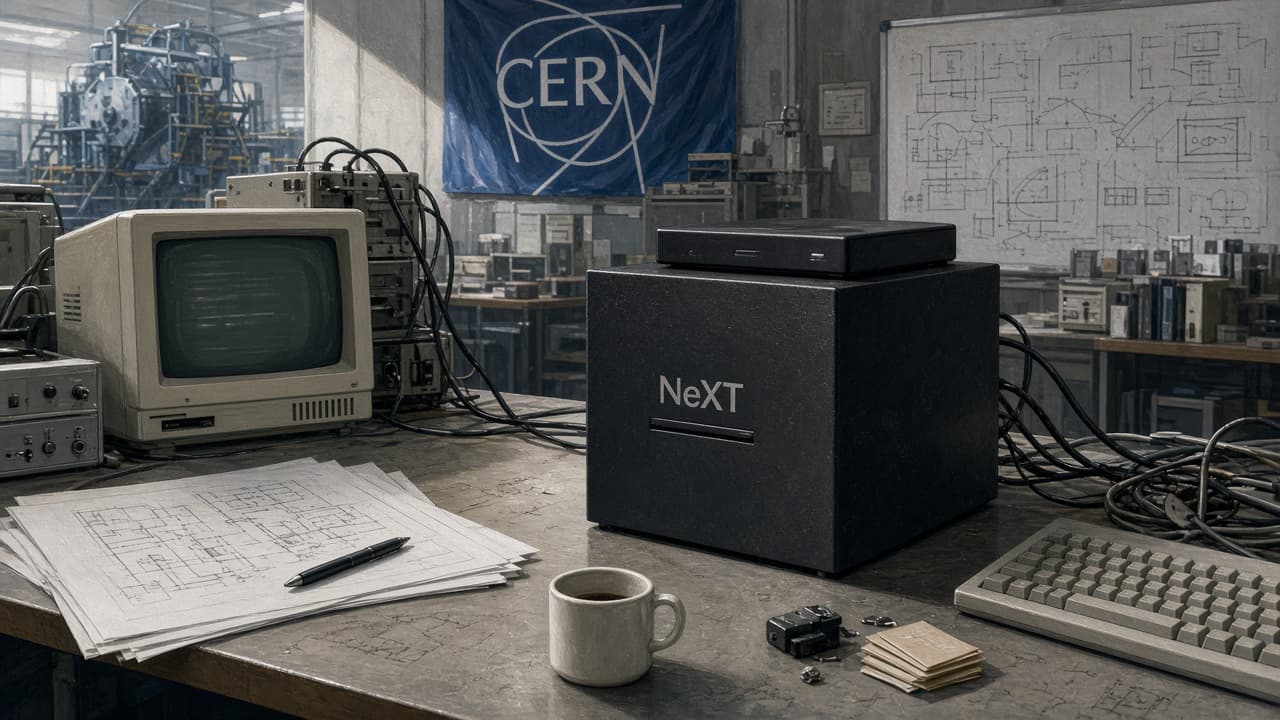
The date needs one correction that is often got wrong. The first website did not go live on 6 August 1991. Berners-Lee had a server running on his NeXT workstation at CERN and the first pages readable at info.cern.ch by around 20 December 1990, roughly eight months earlier. What happened on 6 August 1991 was the public announcement and the release of the code beyond the lab, in that newsgroup post and in companion messages to groups including comp.sys.next.announce and comp.text.sgml. If you want a single date for the Web becoming available to the world rather than to physicists, this is the defensible one.
The problem he was trying to solve was mundane, which is part of why the solution generalised so well. CERN was a churn of several thousand scientists on short contracts, using incompatible computers, documenting experiments in incompatible formats, and leaving. Knowledge kept walking out of the building. Berners-Lee had written a personal program called Enquire in 1980 to keep track of who worked on what, and in March 1989 he submitted a document titled Information Management: A Proposal to his managers. His boss Mike Sendall wrote vague but exciting on the cover and, more usefully, approved the purchase of a NeXT machine. A revised 1990 version, co-signed by the Belgian engineer Robert Cailliau, gave the thing its name.
The design rested on three inventions that had to work together, and each one was a deliberate simplification of something more ambitious. The first was a way to name any document anywhere, the address now called a URL. The second was a minimal request protocol, HTTP, in which a browser opens a connection to a server, asks for one named resource and receives it. The third was HTML, a small markup language borrowed in spirit from the publishing standard SGML, which let a plain text file carry headings, lists and, most importantly, links pointing at other addresses. A fourth piece was software: a browser that was also an editor, written on the NeXT and confusingly named WorldWideWeb, plus the server to talk to.
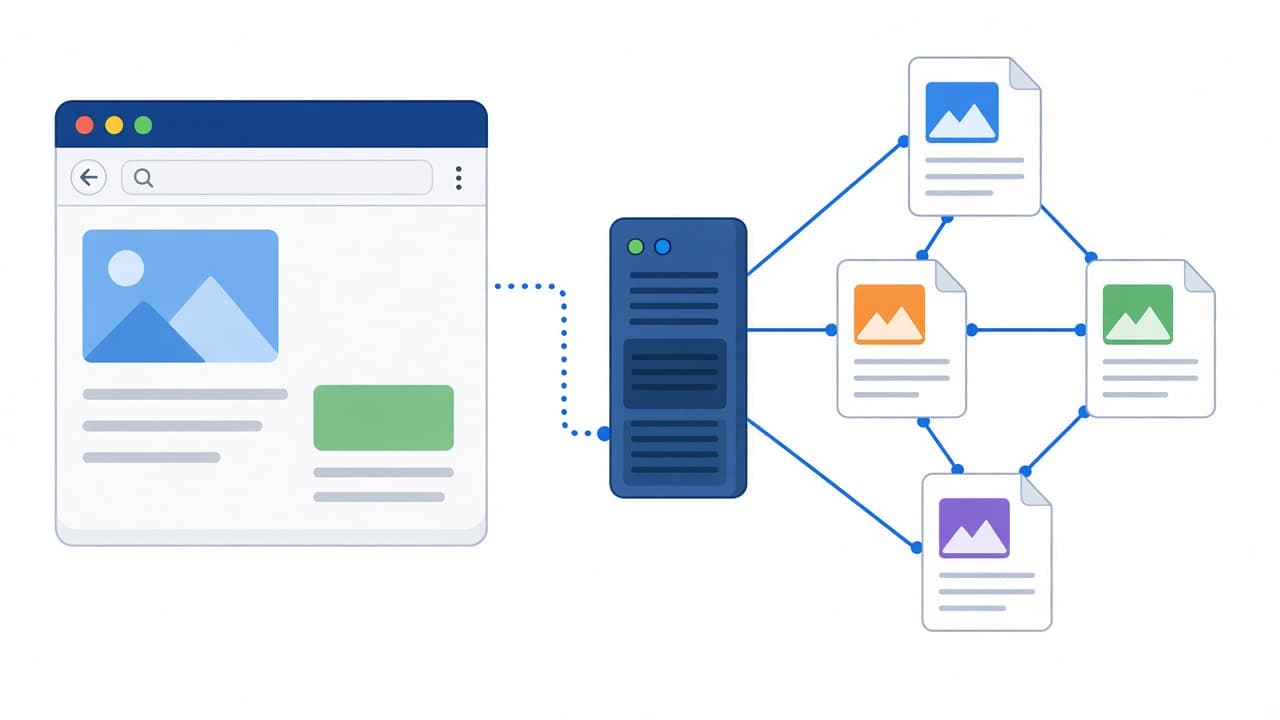
It helps to separate two things people still confuse. The internet is the network, the cables, routers and the TCP/IP addressing scheme that lets any connected machine exchange packets with any other, and it had existed in some form since the 1970s. The Web is an application that runs on top of it. Before 1991 the internet already carried email, file transfers, Usenet discussion and search systems such as Archie, WAIS and, shortly afterwards, Gopher. What the Web added was a single addressing scheme for documents and one-click links between them, so a reader did not need to know which machine held what or which program to run. Gopher was arguably easier to use in 1992. It lost partly on design and partly because the University of Minnesota announced license fees in 1993.
CERN's decisive contribution came in April 1993, when it released the Web software into the public domain, followed by an open license, ensuring nobody would ever have to pay to implement HTTP or HTML. Berners-Lee also wrote a line-mode browser so the Web worked on dumb terminals rather than only on expensive NeXT hardware, which mattered enormously for adoption inside universities. Other people then built better browsers. Viola, Erwise and Midas came first. In 1993 Mosaic, written by Marc Andreessen, Eric Bina and colleagues at the National Center for Supercomputing Applications in Illinois, put inline images in pages and installed easily on Windows, Mac and Unix. Its descendant Netscape Navigator arrived in 1994 and the number of websites went from hundreds to tens of thousands within two years.
Berners-Lee made a choice at this point that shaped the next thirty years. He did not start a company. He moved to the Massachusetts Institute of Technology and in October 1994 founded the World Wide Web Consortium, a standards body where competing browser makers, publishers and researchers argue out specifications in public. Not everything it produced was adopted and browser makers repeatedly went their own way, but the principle that the core protocols belong to nobody survived. The counterfactual is easy to imagine. A proprietary Web licensed from CERN, or from a Berners-Lee startup, would have been a product rather than a commons.
The consequences arrived faster than anyone in the 1991 newsgroup thread expected. Commercial use of the internet was permitted in the United States from the early 1990s. Amazon and eBay launched in 1995, Google in 1998, Wikipedia in 2001, Facebook in 2004. Whole industries were rebuilt around a document format designed for physics papers. Berners-Lee received the Turing Award in 2016 and was knighted in 2004, and he has spent much of the last two decades arguing that the Web he built has been captured, pressing for open data, against surveillance business models and for his Solid project, which tries to hand personal data storage back to individuals.
It is worth reading the original announcement for its tone. The post is modest, technical and almost apologetic, closer to a plea for collaborators than a manifesto. It ends by inviting readers to try the software and report back. The thread that followed contains ordinary usenet grumbling about markup and interface choices. Nobody present, including the author, wrote anything like a prediction of what the thing would become, which is normally true of the announcements that turn out to matter.
Eagle Frame's takeaway: 6 August 1991 is the day the Web stopped being an internal CERN tool and became something anyone could download. The first page had already been online since December 1990, so treat this anniversary as the invitation rather than the invention, and note that the decision to give the standards away for free is the reason it spread at all.