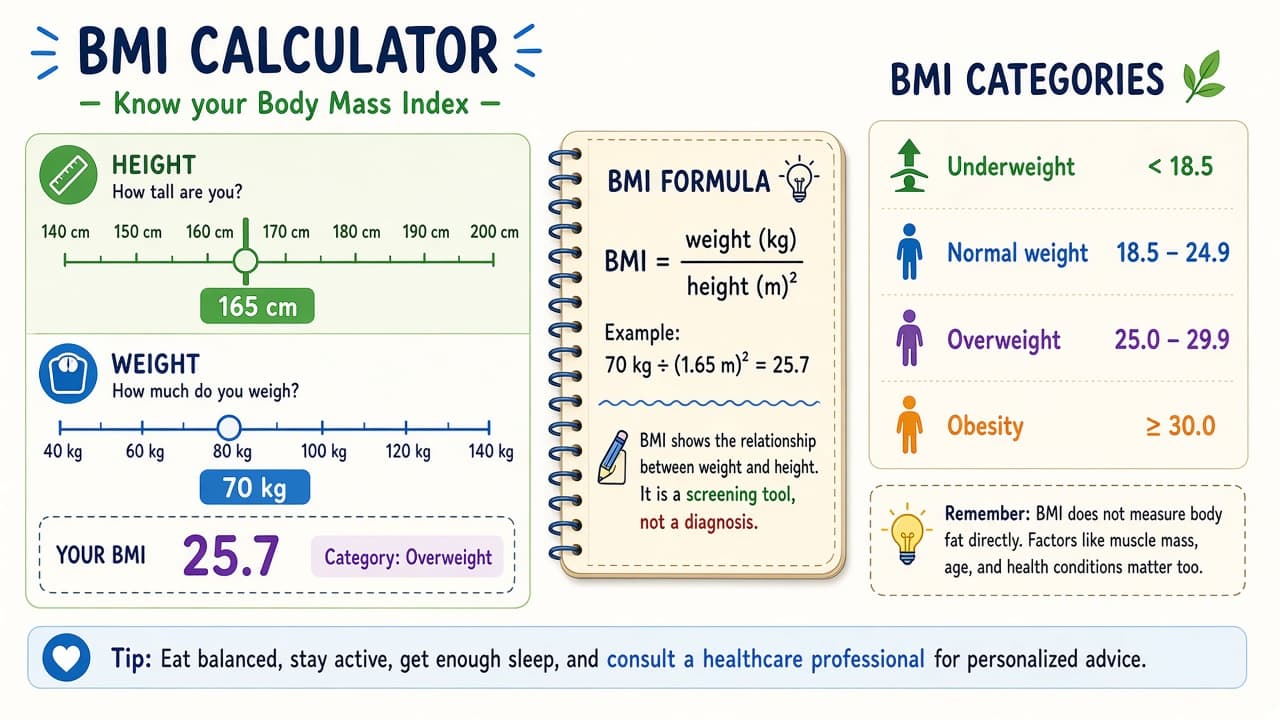
How to calculate BMI
Calculate body mass index with the metric or imperial formula, then read the result as a rough screening number with clear limits for muscle, age and health context. It is not a diagnosis.
BMI means body mass index. It is a simple ratio of weight to height used in many clinics and public-health charts as a screening tool. It is not a direct measure of body fat and it is not a diagnosis of health on its own.
This guide is not a substitute for medical care. A clinician interprets BMI beside bloodwork, medications, muscle mass, age and other risks. Athletes with high muscle, older adults, children and some ethnic groups may need different clinical judgment than a generic adult chart suggests.
Metric formula: weight in kilograms divided by height in meters squared (kg/m²). Imperial shortcut often used in the U.S.: pounds divided by inches squared, then multiplied by 703. Work carefully with the units you measured.
Adult charts commonly label underweight, healthy weight, overweight and obesity ranges by BMI bands. Those labels are population tools. They do not tell you your fitness, vitamin status or whether a specific diet is safe.
Step-by-step guide
Time: 10 to 15 minutes
What you need
- Accurate scale
- Wall height measure or stadiometer-style marking
- Calculator
- Notebook for the result and date
Before you start
- Not a substitute for medical care. BMI alone does not diagnose disease or dictate treatment.
- High muscle mass, pregnancy, amputation, edema and certain ages can make BMI misleading. Ask a clinician how to interpret your number.
- Do not use BMI charts meant for adults on children without pediatric guidance.
Step 01
Measure height and weight carefully
Bad inputs make a neat formula useless.
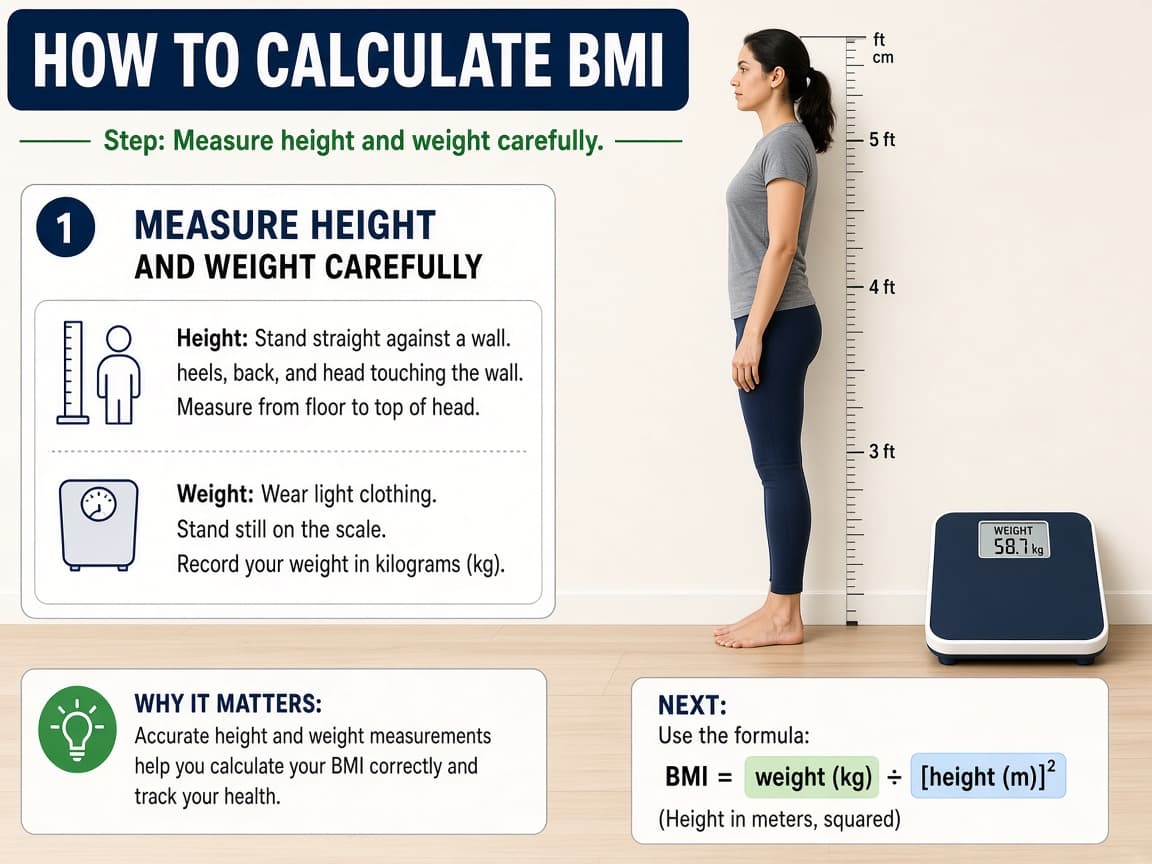
Accurate height and weight come before any calculator. Do this step in order
1a
Weigh at a consistent time
Use a flat-floor scale, preferably in the morning after using the bathroom, in light clothes. Record kilograms or pounds clearly.
1b
Measure height without shoes
Stand straight against a wall, heels together, looking forward. Mark the top of the head and measure to the floor. Record meters (or centimeters) or inches.
1c
Convert units before you mix formulas
If height is in centimeters, divide by 100 to get meters. Do not drop a centimeter-to-meter conversion and still use kg/m².
1d
Skip this as a solo child measurement project
Pediatric growth charts differ. Caregivers should use clinician guidance for children's BMI-for-age.
Step 02
Calculate with the metric formula
Metric BMI is weight (kg) ÷ height (m) ÷ height (m) or weight ÷ height².
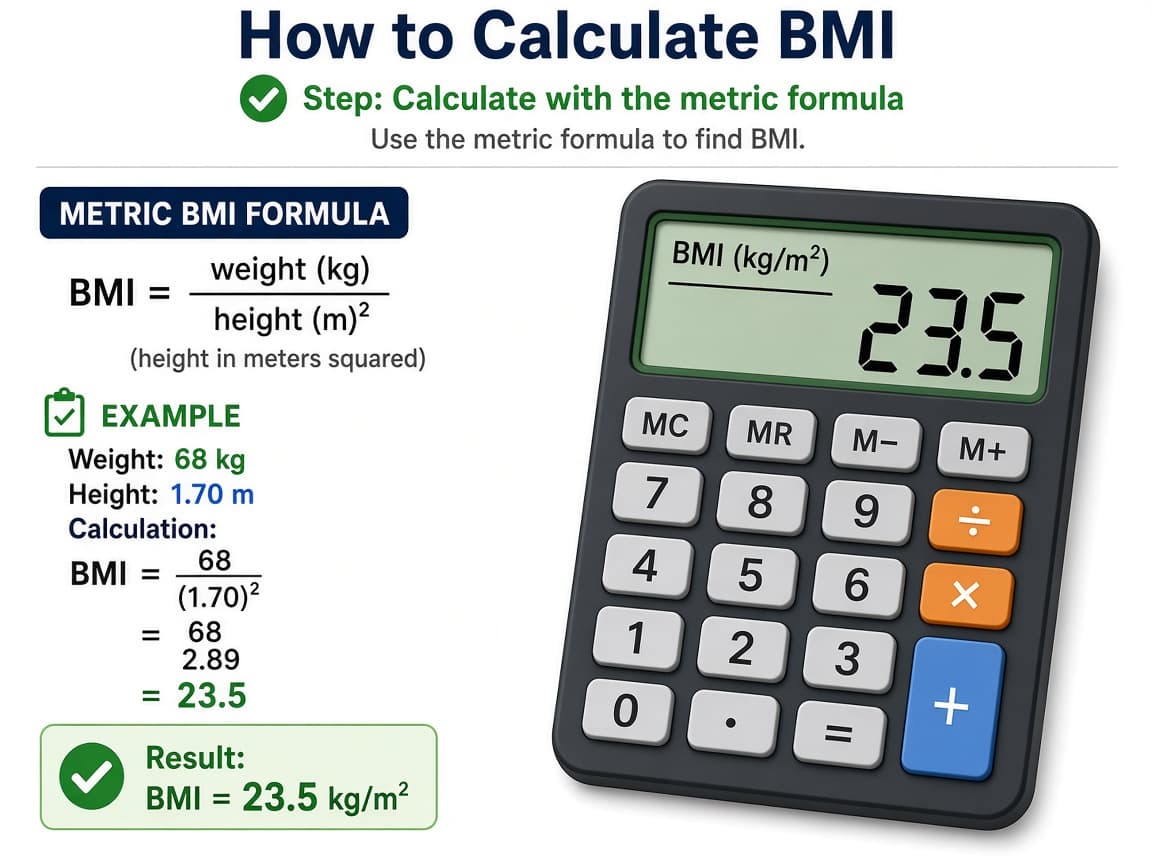
kg divided by meters squared is the standard metric path. Do this step in order
2a
Write height in meters
Example: 170 cm becomes 1.70 m. Square it: 1.70 × 1.70 = 2.89.
2b
Divide weight by height squared
Example: 70 kg ÷ 2.89 ≈ 24.2. That result is BMI in kg/m².
2c
Round sensibly
One decimal place is enough for personal screening. Do not chase extra digits that imply false precision.
2d
Recheck if the number looks impossible
A BMI of 5 or 80 usually means a unit error. Re-measure and recalculate before you panic or celebrate.
Step 03
Use the imperial formula when you work in pounds and inches
U.S. customary shortcut: (weight_lb ÷ height_in²) × 703.
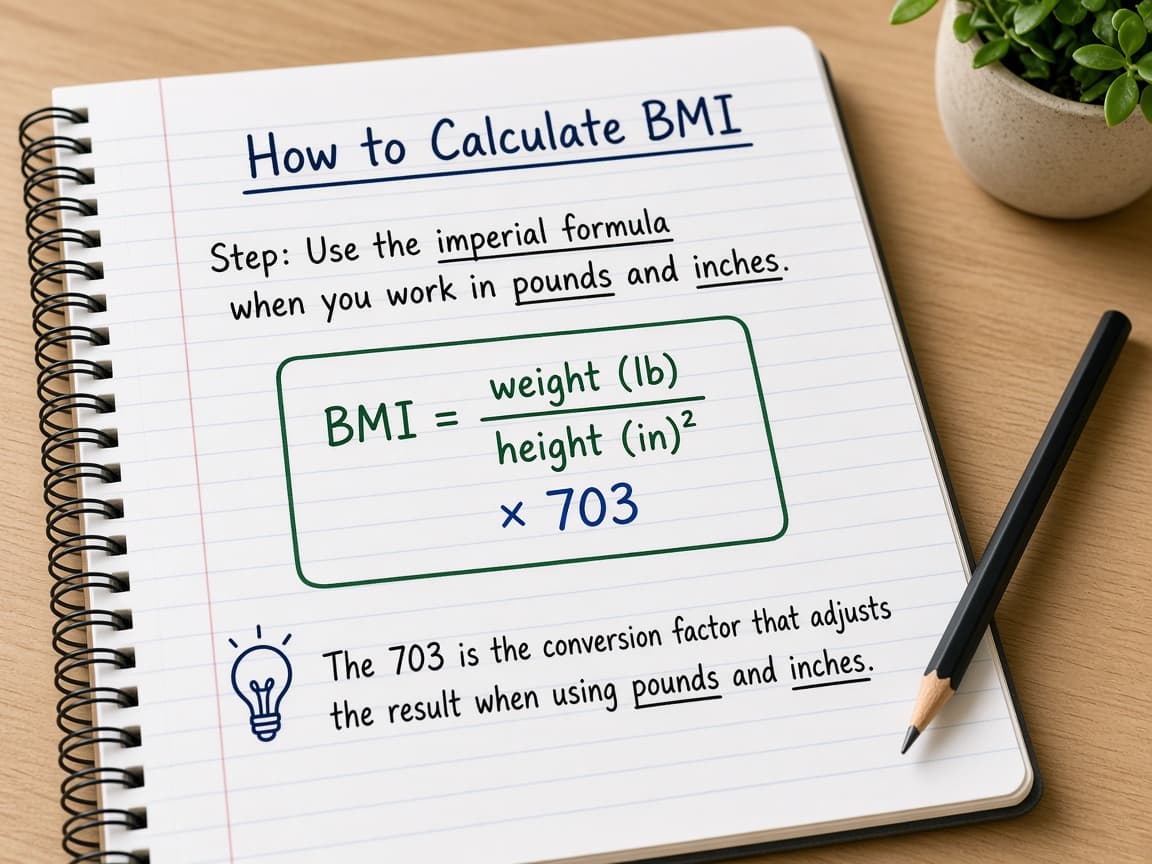
Multiply by 703 only when weight is in pounds and height is in inches. Do this step in order
3a
Measure height in inches
Example: 5 feet 7 inches is 67 inches. Square that number.
3b
Divide pounds by inches squared, then × 703
Example pattern: weight ÷ (height × height) × 703. Keep the 703; forgetting it wrecks the result.
3c
Do not mix metric weight with inch height
Pick one system. Mixing kg with inches without conversion produces nonsense.
3d
Compare with a clinic calculator if you want a check
Many health systems publish BMI calculators. Use them to verify your hand math, then still ask a clinician about meaning.
Step 04
Read the number with limits and clinical context
Charts help screening. People are more than a ratio.
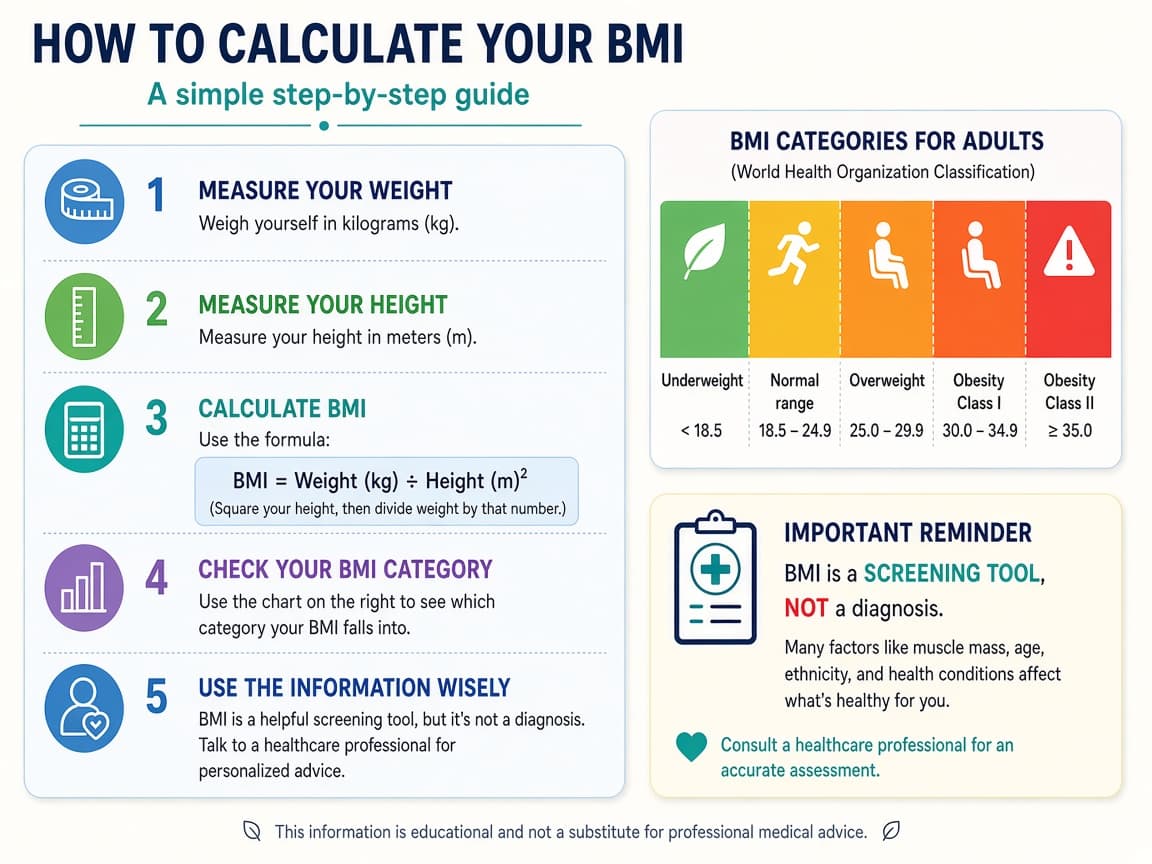
Category labels are screening language, not a full exam. Do this step in order
4a
Know common adult category bands
Many adult charts treat under 18.5 as underweight, 18.5 to 24.9 as healthy weight range, 25 to 29.9 as overweight and 30-plus as obesity ranges, with further subclasses. Your clinician may use slightly different framing.
4b
Remember muscle, age and body composition limits
A muscular person can land in 'overweight' with low body fat. An older adult can have a 'normal' BMI with low muscle. Waist size and labs often add context.
4c
Do not self-prescribe extreme diets from a single number
If BMI flags a concern, the next step is clinical advice and sustainable habits, not a punitive crash plan from social media.
4d
Bring the result to a clinician when health decisions follow
Medications, blood pressure, glucose and family history matter beside BMI. Ask how the number fits your plan. This article cannot personalize that answer.
Done when
- Height measured accurately
- Weight measured on a reliable scale
- Correct formula used for your units
- Result recorded with date
- Limits of BMI understood before you act on the number
Eagle Frame's takeaway: measure height and weight accurately, run kg/m² or the 703 imperial formula and treat the number as a rough screen. Talk with a clinician about what it means for you. BMI is math plus context, not a full health verdict.