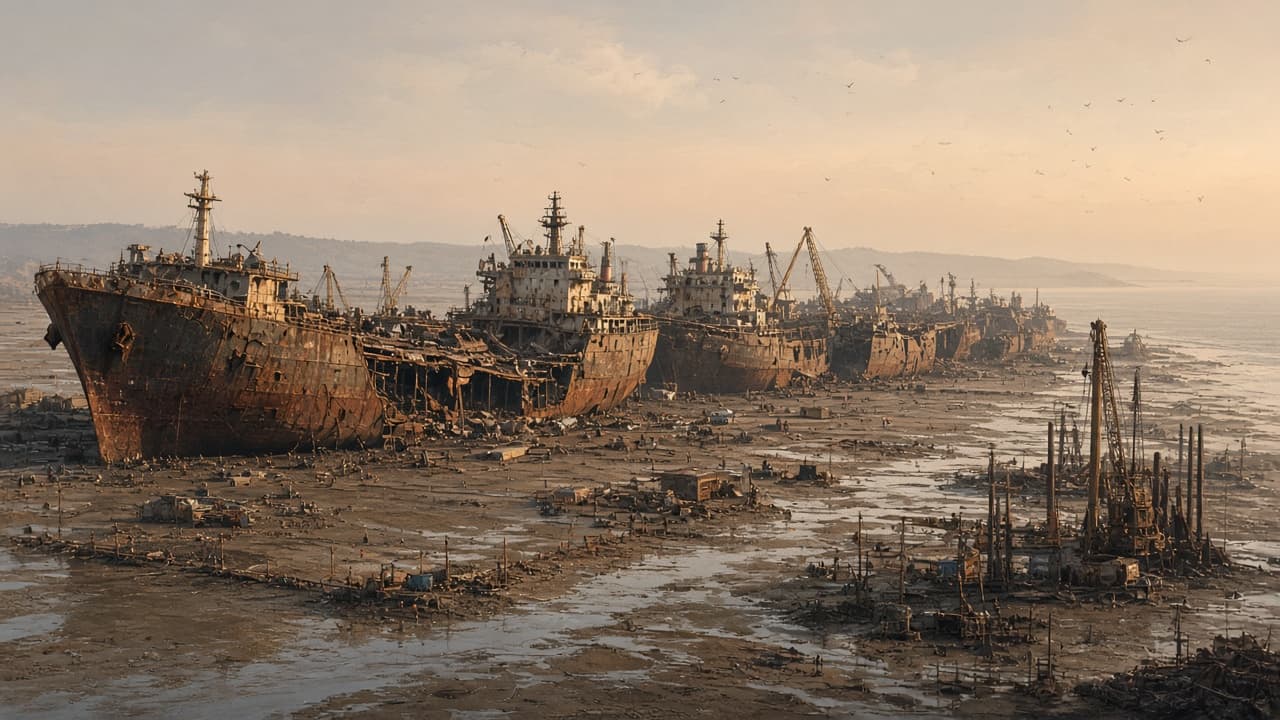
Alang: the 10-kilometre beach where the world's famous ships go to die
SS France, Exxon Valdez and the largest tanker ever built were unbuilt here. Beaching is sold as a circular economy and fought as a toxic mudflat. Cabins become secondhand furniture, ovens and brass portholes on the Gujarat strip.
Annual count of vessels delivered for recycling. Peak year 2011-12 versus the recent slump.
415ships
Peak year
Ships. Figures shown for this story. 2011-12 to 2018-19 from the Gujarat Maritime Board. 2022-23 to 2024-25 from Gujarat government figures reported for those financial years.
On about 10 kilometres of Gujarat mud, transatlantic flagships and the largest supertanker in history were run ashore and cut to pieces. That is the nostalgia. The argument is whether beaching is a circular-economy win or a toxic disaster. India now works under the Hong Kong Convention, in force from 2025, plus the Recycling of Ships Act, 2019. The bazaar is the surreal part: cruise-ship beds, industrial galleys and brass portholes leave the hull and enter a secondhand economy built entirely on dead ships. The place is the Alang-Sosiya Ship Recycling Yard on the Gulf of Khambhat, near Alang in Bhavnagar district. For decades it has been the largest site on Earth where ocean-going ships are beached and taken apart for steel, machinery and everything still bolted inside.
A ship-breaking yard is an industrial beach, not a scrap heap in the ordinary sense. Owners sell a vessel that is too old, too expensive to insure or no longer legal to run. A cash buyer delivers it to a plot. Workers then unbuild it: first the loose goods and hazardous materials, then the steel hull, cut into plates that Indian mills can melt or re-roll. India's government says the cluster does about 98 percent of the country's ship recycling. In 2025 India was also among the world's leading destinations for end-of-life tonnage.
The geography is the machine. The gulf here has a huge tidal range, often described as around 10 metres. At high tide a captain can drive a ship hard onto the sloping mud of a numbered plot. When the water falls away, the hull sits on the flats like a beached whale. That method is called beaching. It is cheaper than a dry dock because the sea itself is the slipway. It is also the reason regulators argue: the hull sits on intertidal mud, not in a sealed basin.
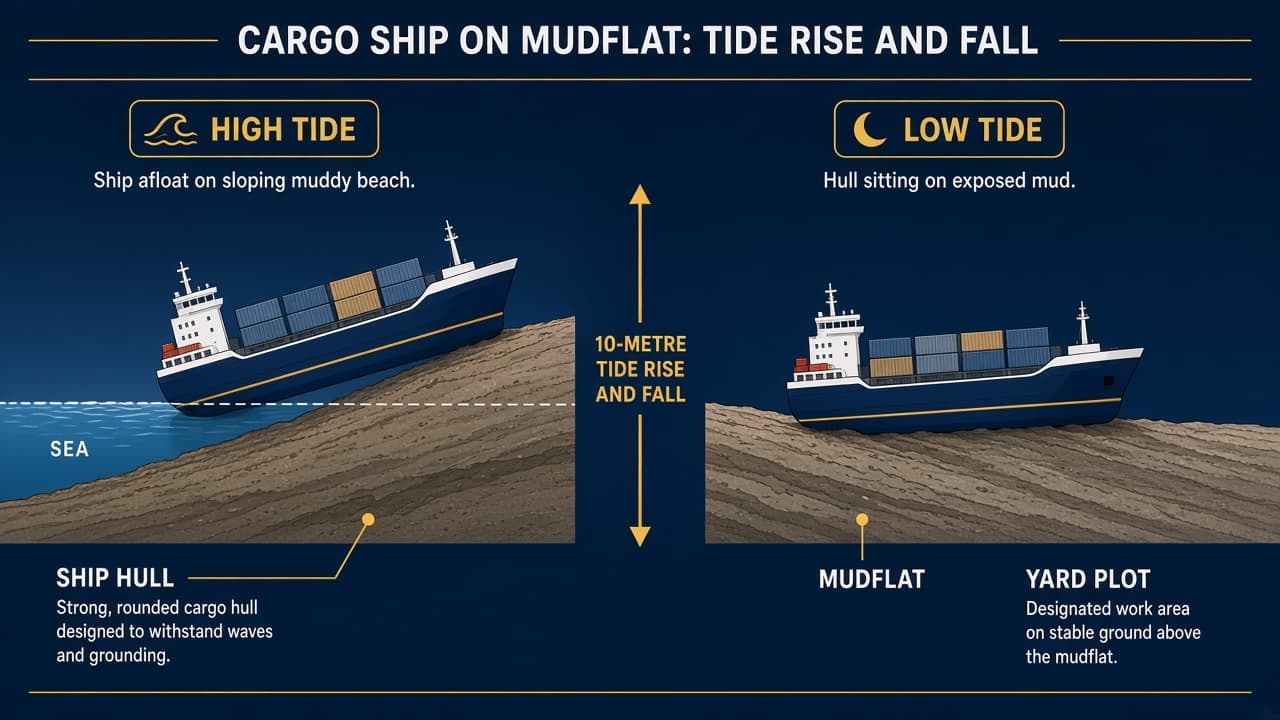
The coastline of plots runs for about 10 kilometres between Alang and neighbouring Sosiya. The Gujarat Maritime Board lists 153 plots on that shore. A full job can take weeks for a small bulk carrier or close to a year for a giant tanker. Buyers, plot owners and contractors form a chain that starts in international cash-sale markets and ends in local steel and spare-parts shops.
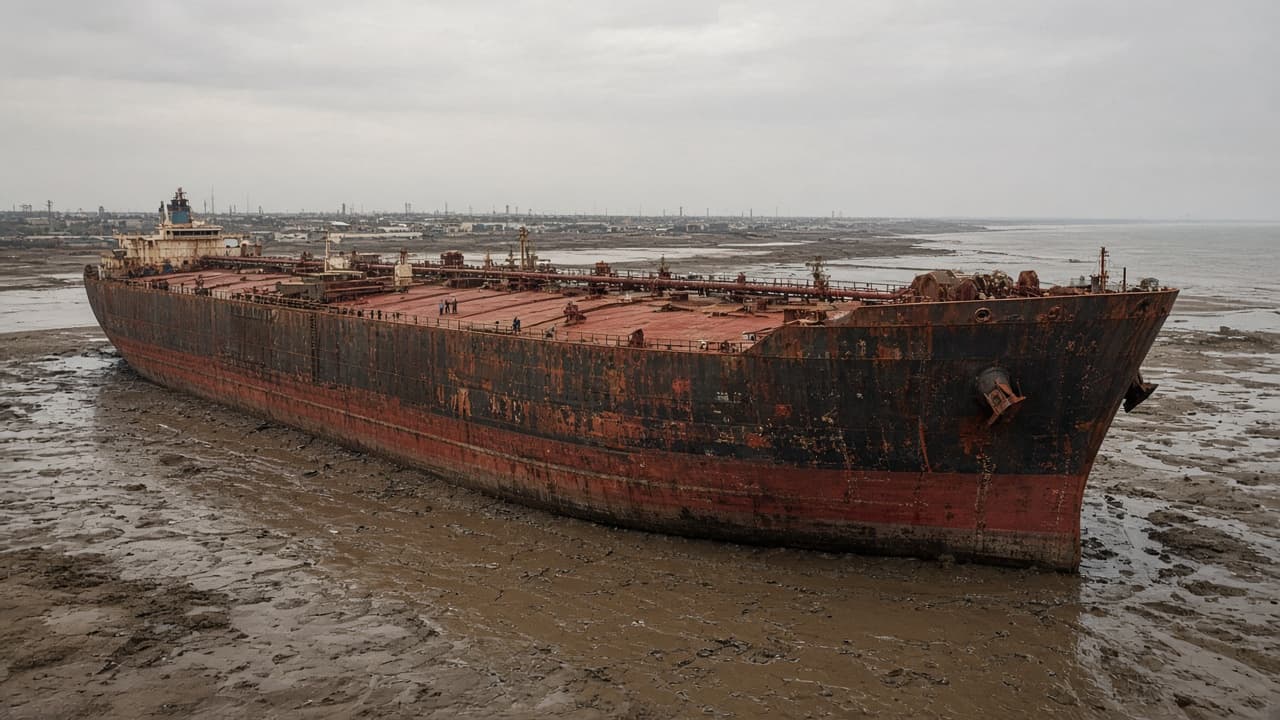
The most famous hulls are not anonymous bulk carriers. In December 2009 the crude carrier Mont beached at Alang. She had been the Seawise Giant, then Jahre Viking, then Knock Nevis: the longest ship ever built, about 458 metres, with a deadweight around 565,000 tonnes. The GMB still records her as the largest ship recycled there, at 83,598 tonnes light displacement. Priya Blue Industries took the job. Officials said it would take about a year. That single arrival is the yard's calling card: if the biggest tanker in history can be unbuilt on this mud, almost anything can.
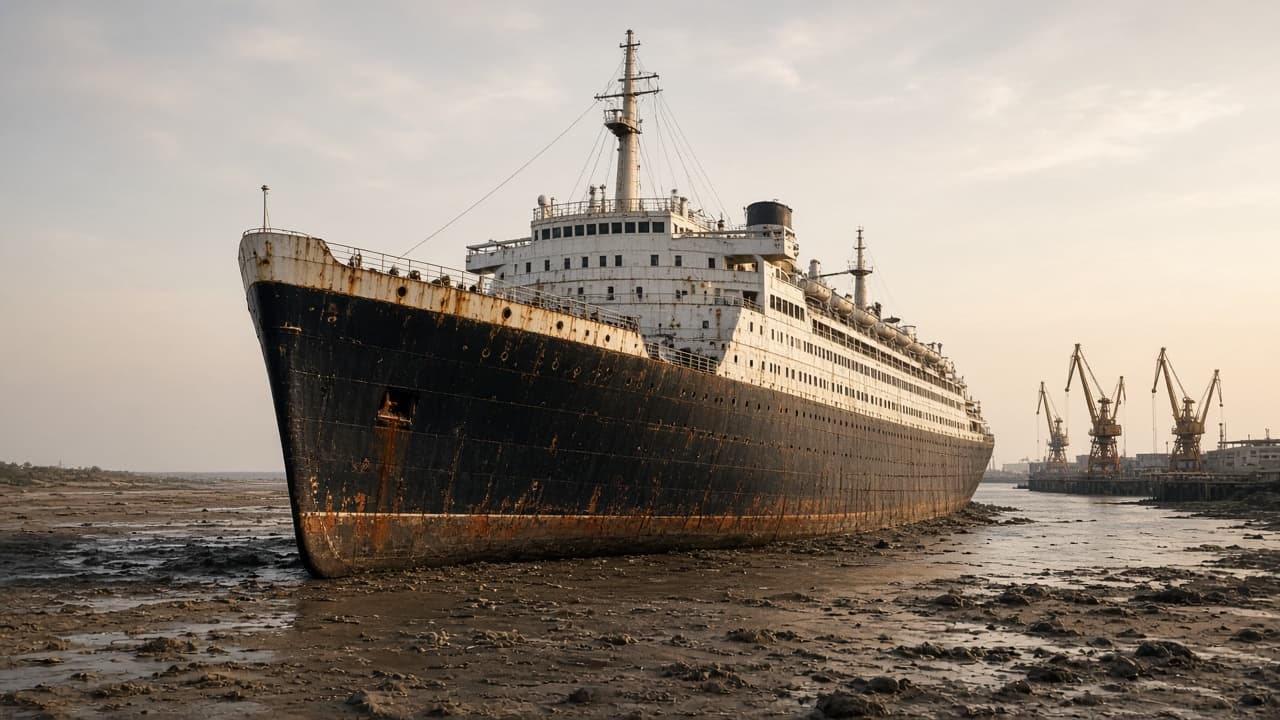
The liner that still haunts ship-lovers is SS France, later Norwegian Cruise Line's SS Norway, beached in 2006 as Blue Lady. France built her as a transatlantic flagship. After a boiler explosion in Miami in 2003 she was sold toward Asia, refused by Bangladesh as a "toxic ship" and towed to Gujarat. India's Supreme Court allowed dismantling in 2007 after a technical committee report. Priya Blue cut her. Academic and court records put her light displacement near 47,700 tonnes and noted large volumes of asbestos-containing material. Cabins yielded televisions, refrigerators, mattresses and hotel kit that fed the Alang secondhand strip.
The tanker the world already knew was Exxon Valdez, renamed Oriental Nicety by the time she reached India. In 1989 she spilled about 11 million gallons of crude in Prince William Sound, Alaska. In 2012 India's Supreme Court allowed her to be broken at Alang after the GMB and Atomic Energy Regulatory Board said she could proceed, with a warning that any hidden toxins found later would be the owner's cost. Scientific American reported a sale near 16 million dollars to Priya Blue and an estimate of about 500 workers over four months. Other well-known passenger ships later followed, including Carnival Tropicale (as Ocean Dream, 2020) and Carnival Celebration (as Grand Celebration, 2021). The French carrier Clemenceau was headed for Alang in 2006 and was turned back. India's first carrier INS Vikrant was broken in Mumbai, not here.
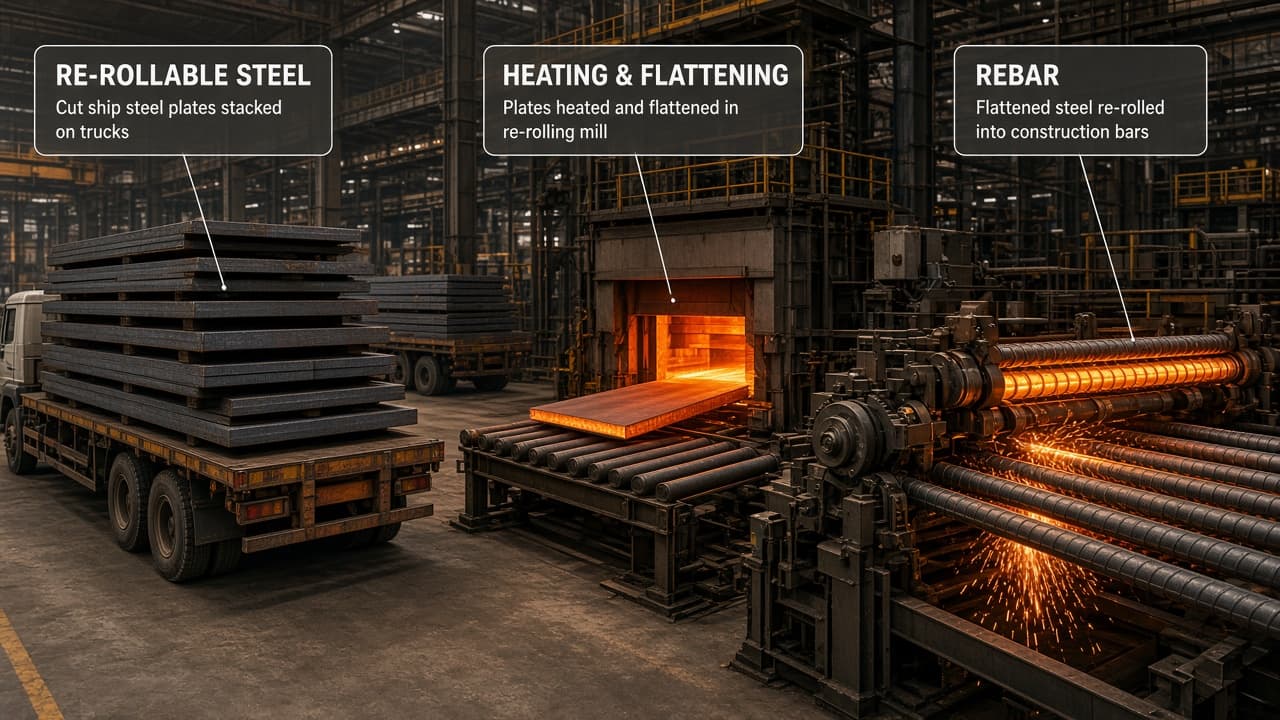
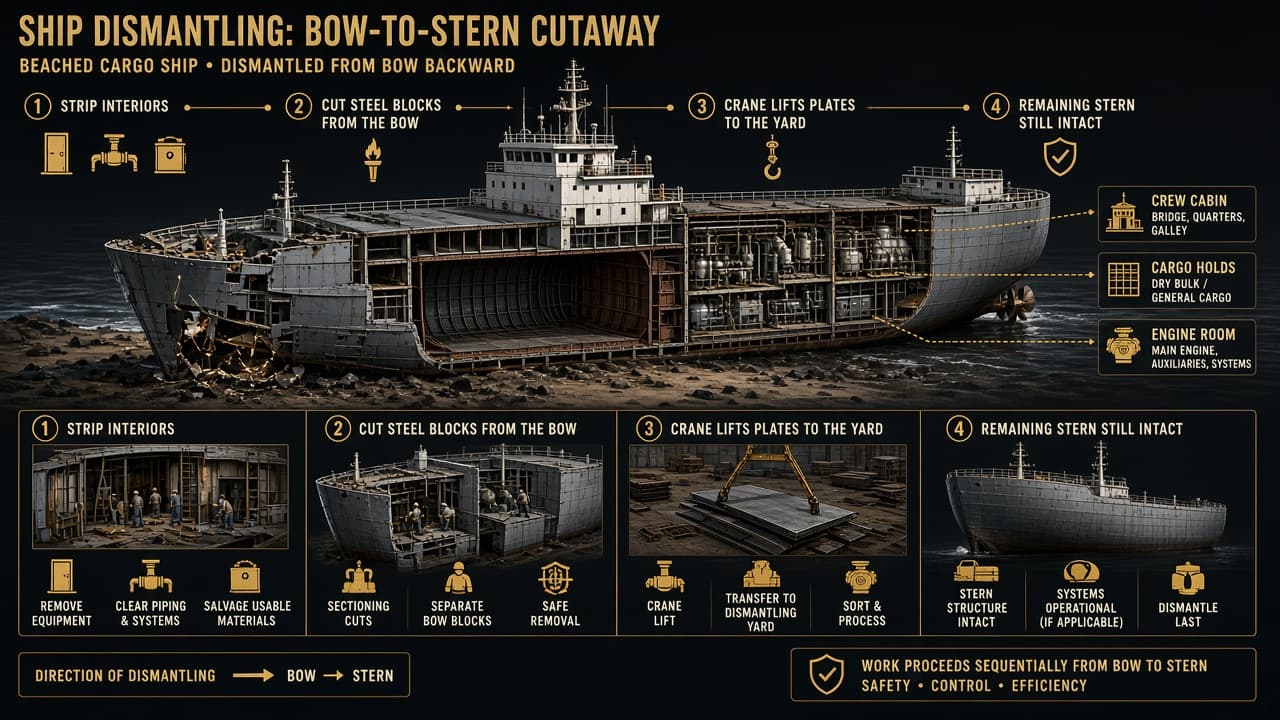
Recycling is a sequence, not a smash. After the high-tide beaching, customs and pollution officers inspect. Fuel and oily residue must be accounted for. A ship-specific recycling plan and an Inventory of Hazardous Materials (a list of asbestos, PCBs, heavy metals and other toxins in the structure) are the paperwork that India's Recycling of Ships Act, 2019, and the Hong Kong Convention now expect. Workers trained at the GMB Safety Training and Labour Welfare Institute strip loose inventory first. Gas cutters then work from the bow toward the stern so the remaining hull stays stable. Cranes drag steel blocks up the plot. Downstream, plates go to re-rolling mills that heat and flatten them into construction steel. Engines, pumps and cabling that still work go to dealers. That is the circular-economy claim: one dead ship becomes bars, spare parts and hotel furniture without mining a new ore body.
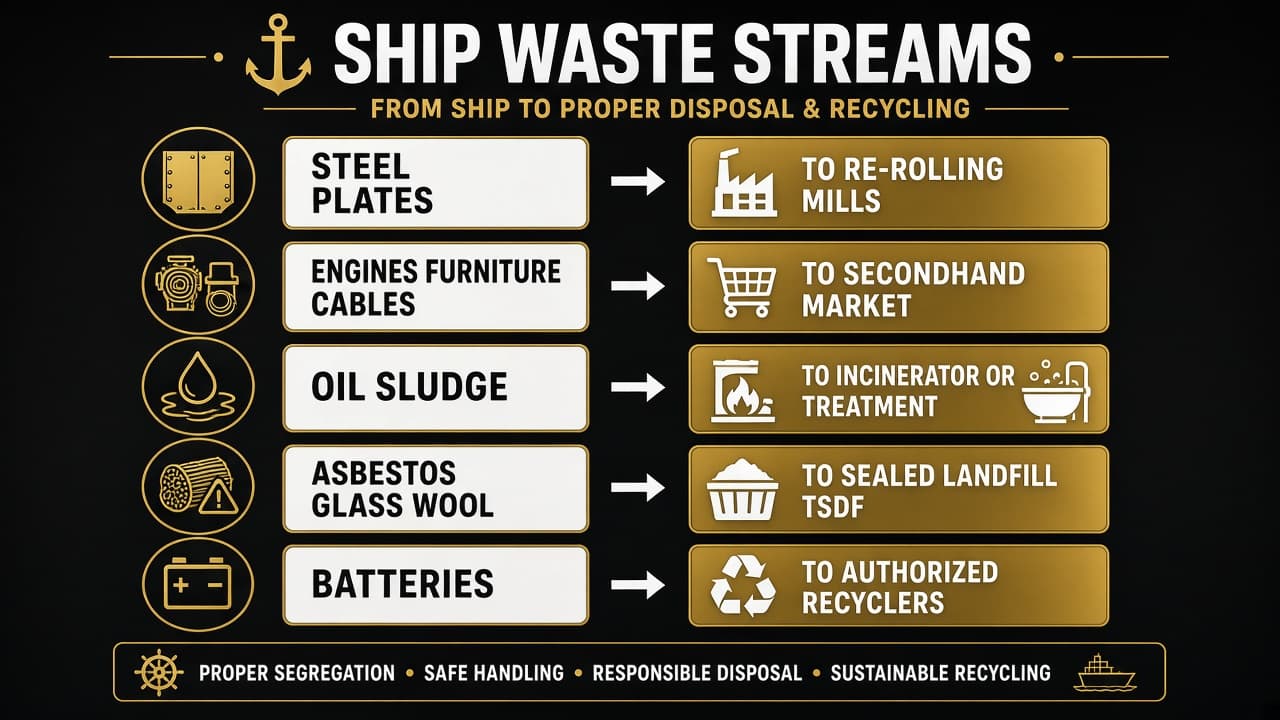
Waste is sorted, at least on paper. Ferrous and non-ferrous metal is the prize. Plastics, rubber, wood, glass and food waste follow municipal or industrial routes. Oil sludge, paint chips and some oily rags go toward treatment or incineration. Lead-acid batteries go to authorised recyclers. Asbestos-containing material and glass wool are supposed to be wetted, bagged and sent to dedicated landfill cells at the Alang Treatment, Storage and Disposal Facility that the GMB built in the mid-2000s and later expanded with an effluent plant and high-temperature incinerator. The Gujarat Pollution Control Board is the state enforcer. A MoEF-linked monitoring report listed those waste types in plain terms: if they miss the TSDF, they hit the mud, the air or the workers.
The money is real even when the ship count is not. The Economic Times in 2025 described a roughly 10,000-crore-rupee recycling ecosystem around Alang. Direct jobs are about 15,000 on the plots, a figure both the GMB and the Press Information Bureau use. Indirect work is larger and fuzzier: the PIB cites over 1.5 lakh people in transport, re-rolling, shops and services; older GMB copy has claimed as many as five lakh. Most cutters and fitters are migrant men from Odisha, Uttar Pradesh, Bihar and other states, paid by the job and housed in labour colonies. When ships are scarce, shops fill with Chinese imports and yards sit at a fraction of capacity. When ships are plentiful, Bhavnagar's trucks, hotels and steel traders fill up.
Volume tells the same story. GMB records show a peak of 415 ships and 3.85 million tonnes light displacement in 2011-12. By 2024-25 Gujarat officials counted 113 ships and about 1.01 million tonnes LDT, the lowest in a decade. High freight rates kept old hulls at sea. Local steel prices and the rupee made Indian bids less aggressive. The government still lists about 4.5 million tonnes a year of re-rollable steel as the cluster's potential feed to mills, and a master plan to lift licensed capacity from 4.5 million LDT toward 9 million. A Shipbreaking Credit Note scheme offers owners a credit equal to 40 percent of scrap value if they recycle at an HKC-compliant Indian yard, usable against a slice of a newbuild contract in India. Tax take is not published as a single clean number each year. Industry groups have previously spoken of more than 1,500 crore rupees in taxes in stronger years. Treat that as an order of magnitude, not a 2026 audited line.
Environmental impact is not a slogan. Early academic sampling found sediments at Alang-Sosiya enriched in iron, zinc, manganese and other metals far above background. Oil, paint dust, PCBs and asbestos fibres were the other classic leaks. Greenpeace's late-1990s investigations and later union reports described workers pulling insulation with little protection. A 2019 occupational-health paper warned that past asbestos exposure would still produce mesothelioma cases years after conditions improved. Sixteen percent asbestosis among workers is a figure that circulates in secondary round-ups; treat it as a warning from the old regime, not a 2026 census. After the TSDF opened and GPCB enforcement tightened, a 2021 Environmental Science and Pollution Research paper reported a drop in measured heavy metals versus early-2000s studies. That is progress. It is not a clean beach.
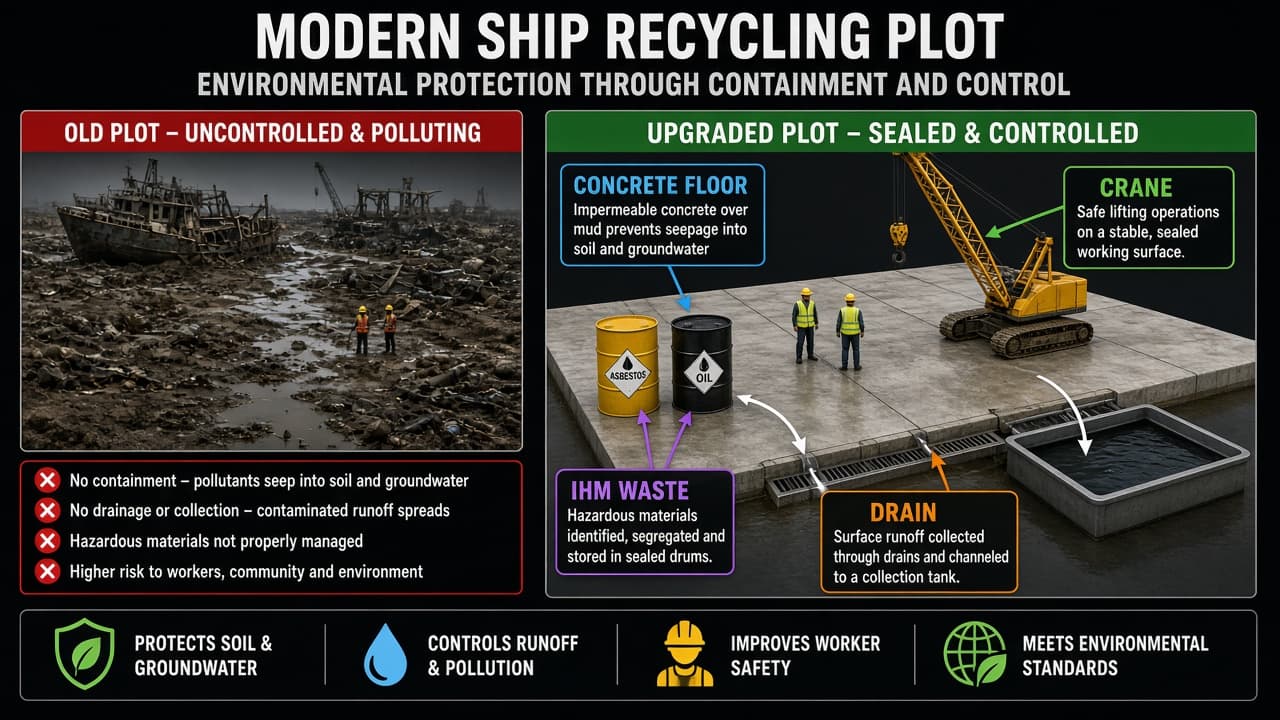
The remaining fight is method. Beaching still puts a hull on intertidal mud. The Hong Kong Convention, in force from 26 June 2025, does not ban beaching. It demands impermeable floors, drainage, cranes, training and tracked hazardous waste. About 115 Alang plots have been listed as HKC-compliant. European campaigners still argue that only dry-dock recycling keeps oil out of the tide. Fires, falls and gas-cutting accidents have not vanished. The honest summary is split: recycling steel here avoids mining and blast-furnace emissions measured per tonne of new iron, and it employs a coastal district. The same process has historically dumped toxins into the gulf and into lungs. Concrete floors and a landfill do not erase that history. They are the bet that the next Mont or Blue Lady is taken apart under rules the last ones were not.
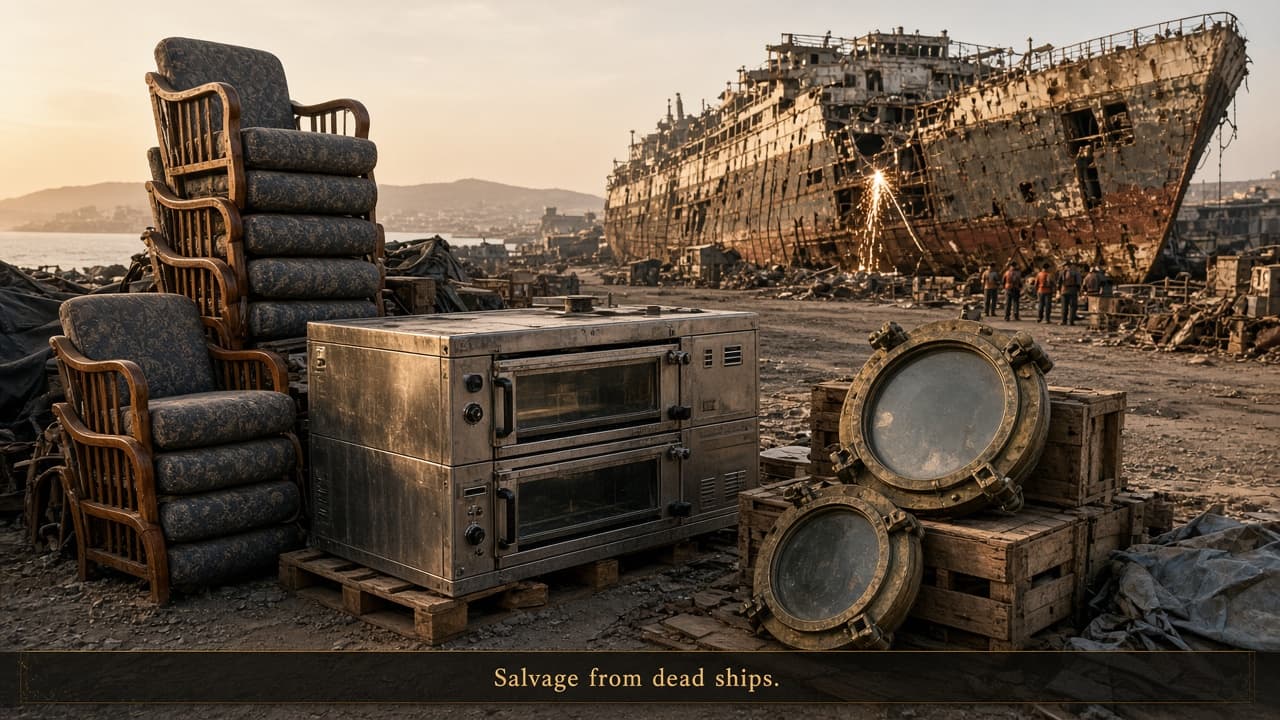
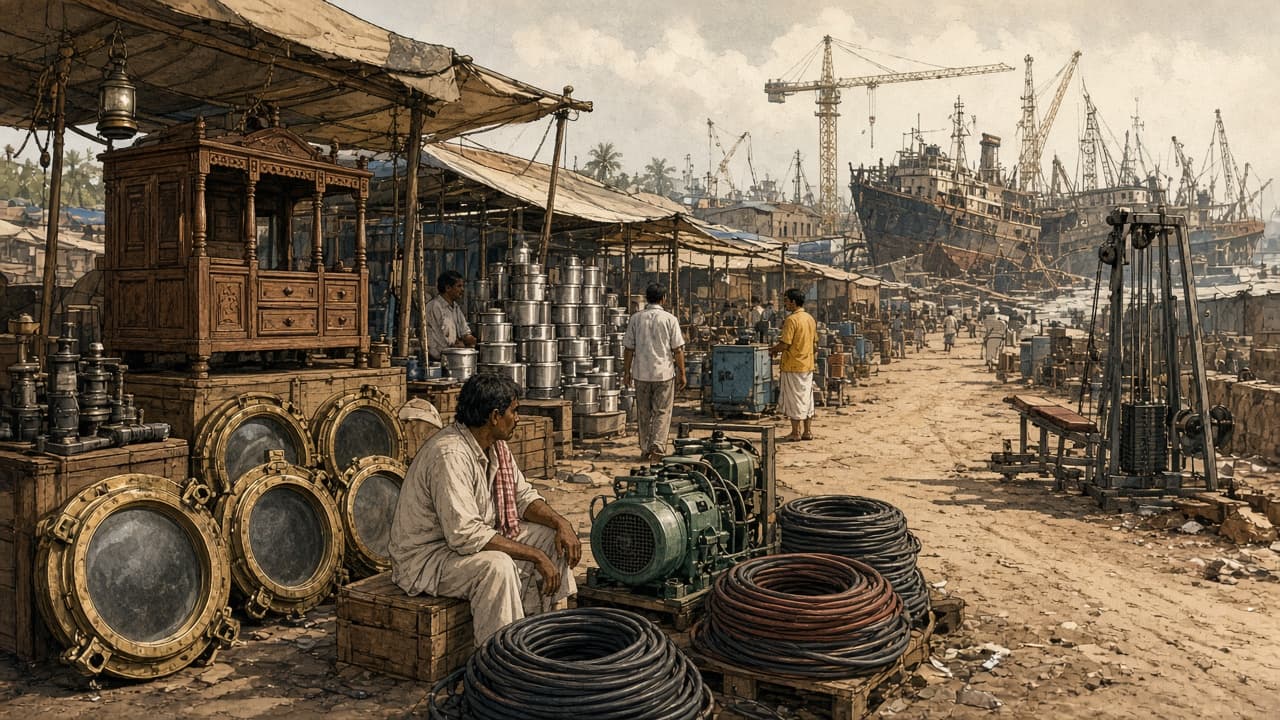
What does not go into a furnace often goes to market. Roads into Alang are lined with shops that sell the ship's second life: marine engines and turbochargers, brass portholes, teak furniture, hotel ovens, gym machines, miles of copper cable. The logic is simple. A liner is usually retired because the hull is tired or the rules have moved, not because every fridge has failed. When ship arrivals fall, as they did through 2024-25, those aisles thin out and cheap imports creep onto the shelves.
If you visit, treat it as heavy industry beside a public road. The GMB restricts photography inside plots. The takeaway is concrete: Alang unbuilt the world's largest ship, France's flagship liner and the Alaska tanker. Steel becomes rebar. Toxins are supposed to hit a landfill, not the gulf. About 15,000 people cut for a living and a much larger town lives off the trucks. The beach still extracts a price in mud, smoke and lung disease that the new rules are trying, late, to price in.