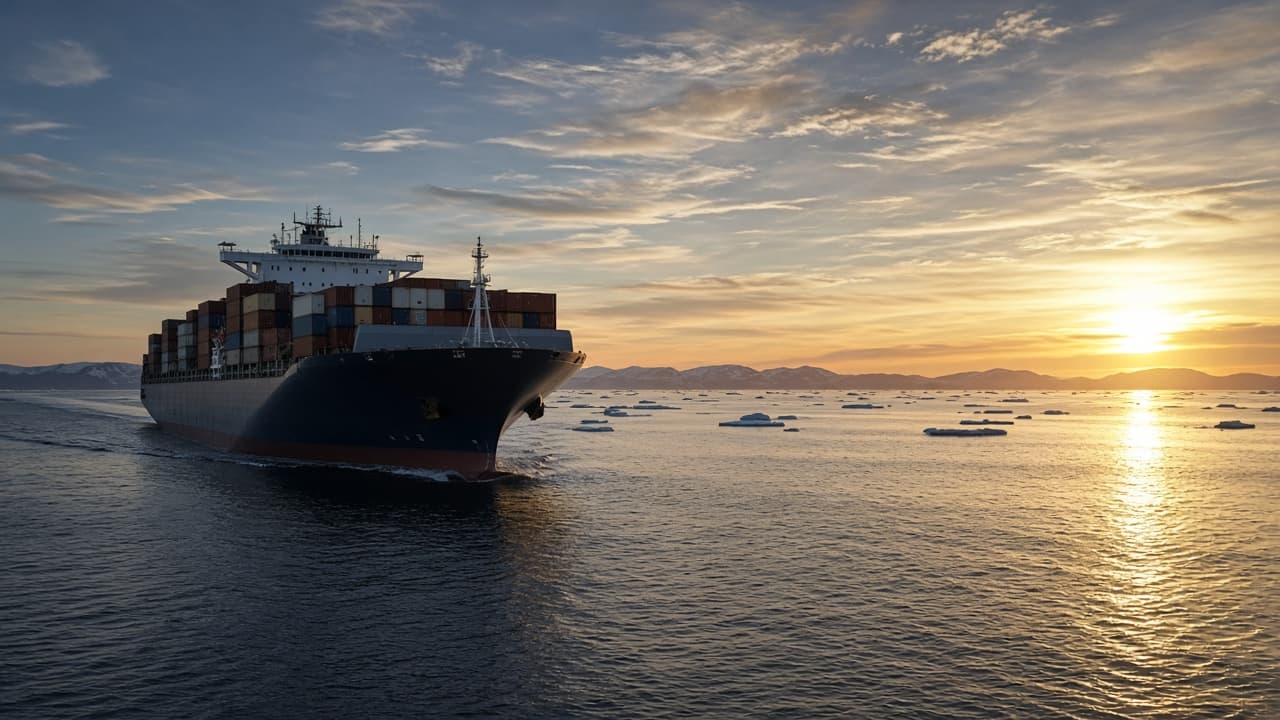
China to Europe in 20 days: the Arctic shortcut and the icebreaker bill
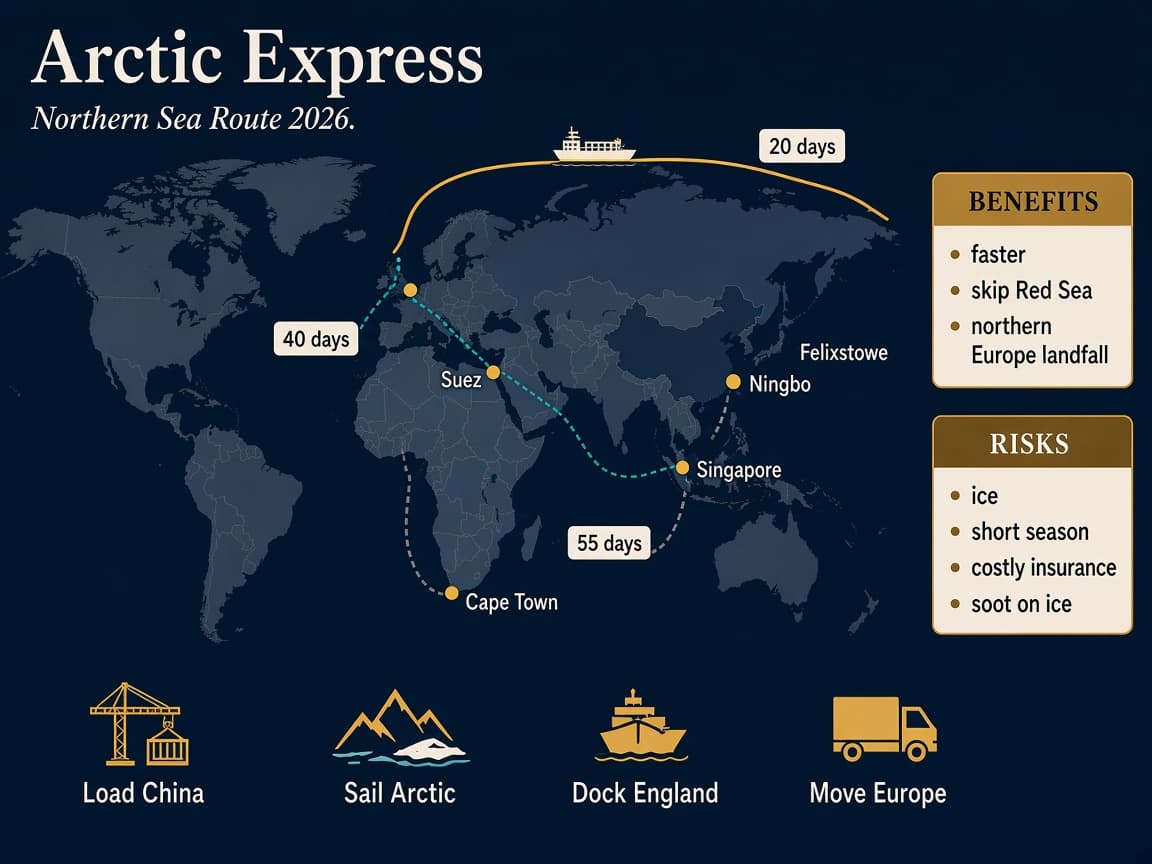
Ningbo to northern England in about 20 days versus about 40 via Suez. The catch: Russian icebreaker escorts and cargo expensive enough to pay for them, like EV batteries.
Insurer and trade-desk figures used in 2026 coverage of Arctic Express sailings. Suez is the classic liner path. The Cape is the Red Sea diversion.
20days
Arctic Express claim
Days at sea. Figures shown for this story. Arctic about 20 days (Ningbo-Felixstowe trial and Allianz-style comparisons). Suez about 40. Cape of Good Hope about 55. China Shipowners' Association cites about 15 days saved Shanghai-Rotterdam versus Suez.
China is selling a 20-day ocean clock to Europe. A classic Suez string is about 40 days. The Cape diversion is about 55. The catch sits in the ice: Russian nuclear icebreakers, six-figure escort and permit bills on larger hulls and cargo that can pay for speed, like EV batteries and solar kit. China is not digging a canal and it is not replacing Suez this year. What opened in 2026 is a scheduled summer container service on a sea lane that already exists: the Northern Sea Route, along Russia's Arctic coast from the Bering Strait toward the Barents Sea and then down to northern Europe. Beijing brands the idea a Polar Silk Road. Moscow issues the permits. Ice and the calendar still run the timetable.
A shipping lane is a practiced path, not a painted line. The Northern Sea Route hugs Siberia's north shore through the East Siberian, Laptev and Kara seas. In winter the pack ice is too thick for ordinary boxships. In late summer the ice pulls back enough that ice-class or escorted ships can pass. Sea Legend, a Chinese operator, marketed an Arctic Express in 2026. Its ship Dubai Tower, about 1,740 twenty-foot equivalent units, left Ningbo in August and made a first 2026 UK call at Teesport after about 20 days, with Felixstowe still on the advertised northern-Europe string. Allianz-style comparisons put Suez near 40 days and the Cape of Good Hope near 55. Versus the Cape, that is nearly half. Versus a normal Suez liner voyage, it is also about half on those desks. The China Shipowners' Association has cited about 3,000 nautical miles and about 15 days saved on Shanghai to Rotterdam versus Suez. The company said Dubai Tower carried about 1,370 TEU of high-value cargo: energy-storage units, power batteries and photovoltaic modules that hate a 50-day Cape detour.
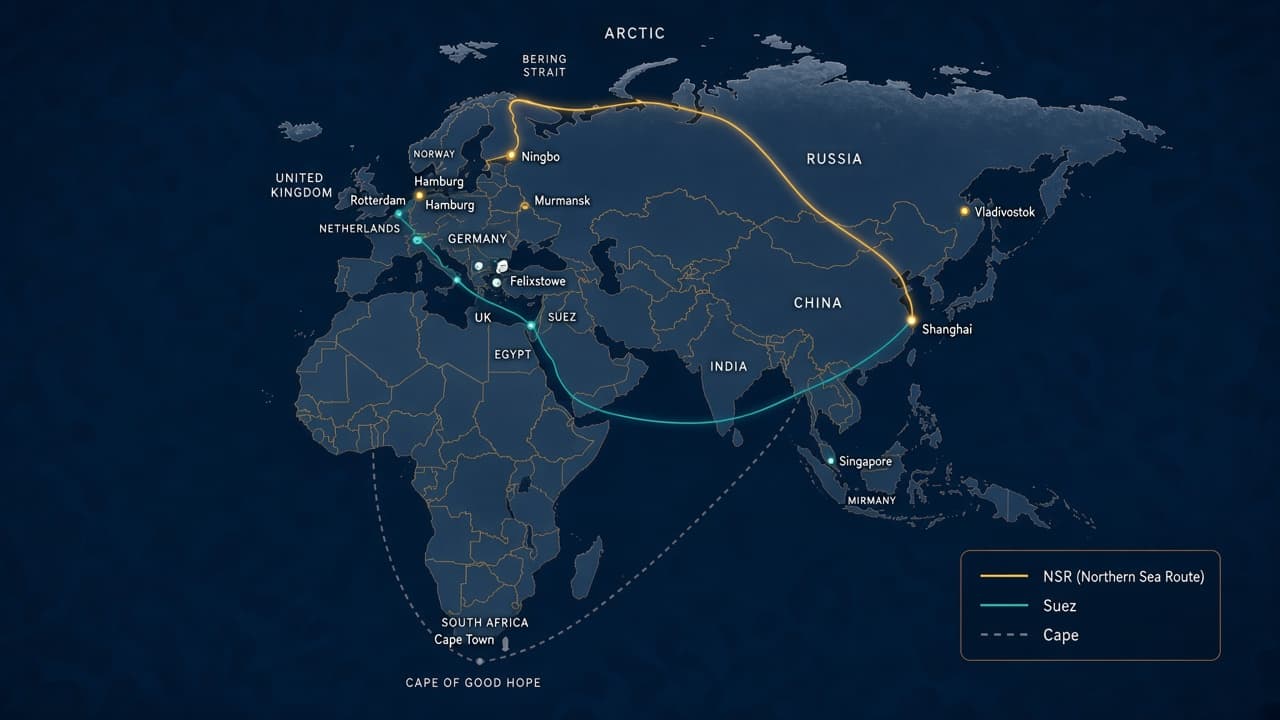
Why now? Three pressures stacked. Arctic summer ice has been thinning for decades, which lengthens the usable window even if it is still only about three to four months for many hulls. Red Sea attacks pushed a large share of Asia-Europe boxes around Africa, adding fuel and time. High bunker prices made a shorter mile count more valuable. Last summer a record for the modern NSR was still tiny next to Suez: on the order of two dozen cargo transits in a season against more than 30 ships a day at Suez and about 13,000 canal transits a year. Sea Legend planned about eight Arctic voyages between August and late October. Six Chinese operators were lining up container and bulk tonnage for the 2026 window, according to association schedules. Some ships would come home through the Arctic. Others would return via Suez or the Cape. That is a seasonal option, not a new world trunk.
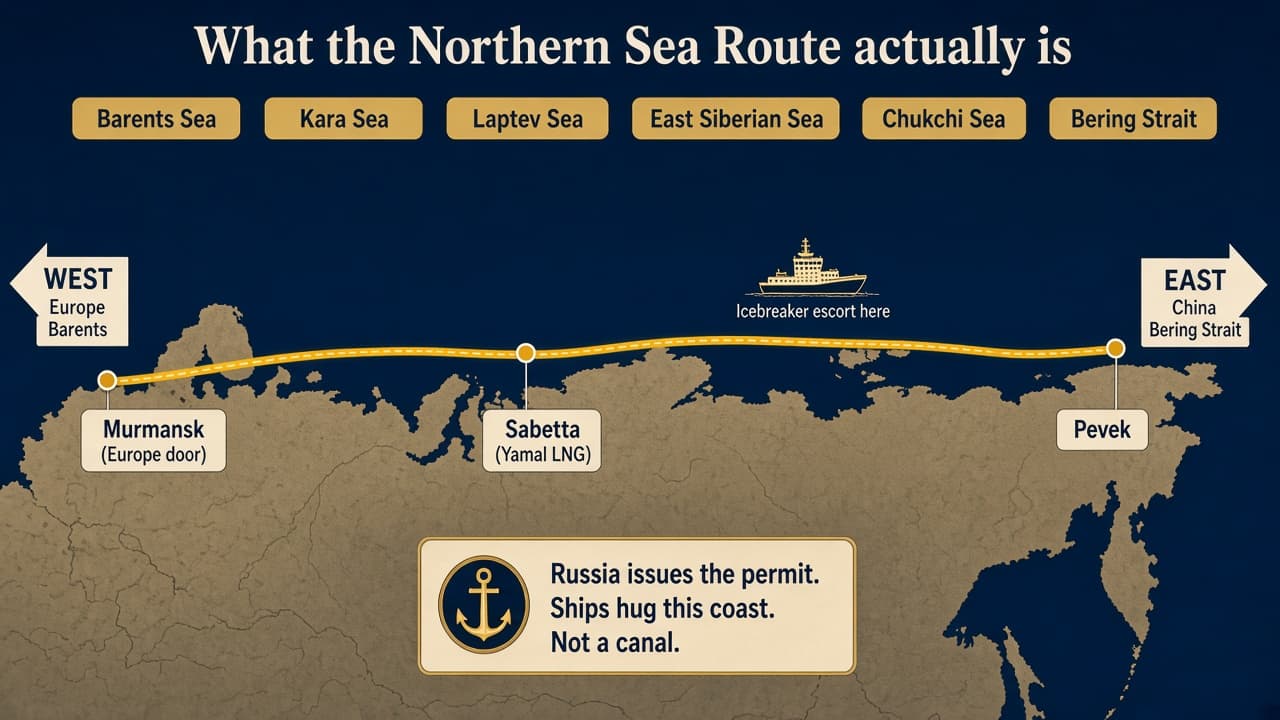
How a voyage works. A ship must meet ice-class rules for the season, file with Russian authorities (Rosatom's NSR administration is the gate) and often take a nuclear icebreaker escort. An icebreaker is a heavy hull with a reinforced bow that rides up on ice and breaks it with weight. The cargo ship follows in the open water. Digital ice charts and satellite radar help captains dodge the remaining floes. Maersk sent a trial containership in 2018. COSCO ran multiple NSR transits in the mid-2010s. The 2026 news is the timetable: advertised sailings, not a one-off stunt. Insurance still prices Arctic risk high. Weather can trap a ship. Search and rescue along more than 5,000 kilometres of coast is thin. Bellona and Russian emergency reporting have warned that a spill or a hull crack can wait days for the right ice-class tug.
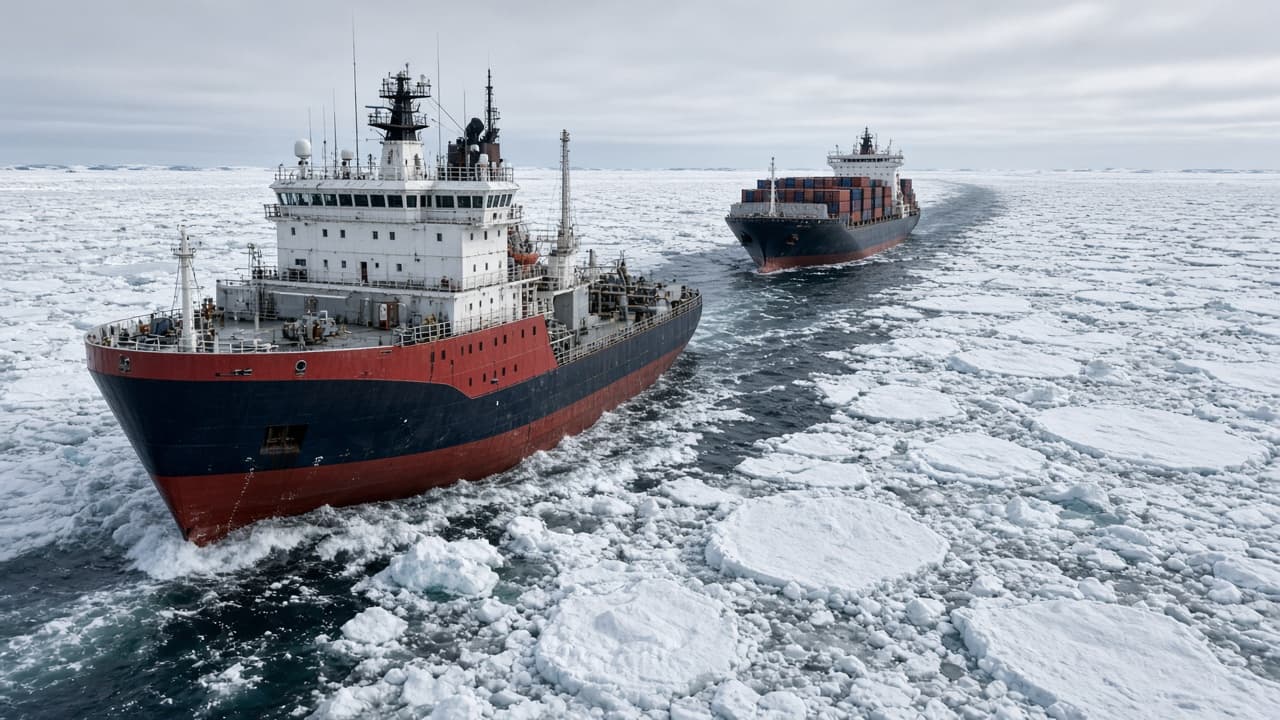
Positive impacts are real for the ships that fit. Fewer days at sea means less fuel per box on that voyage and a faster factory-to-warehouse clock for high-value cargo. Northern European ports such as Felixstowe, Hamburg or Rotterdam sit closer to the exit of the Barents than they do to Suez. For China, the Polar Silk Road is also politics: a Belt and Road story that does not depend on Egypt, the Red Sea or the Strait of Malacca. For Russia, transit fees, icebreaker hire and Arctic ports are cash and leverage after Western sanctions. For exporters watching the Cape diversion, a 20-day option is insurance against another Middle East shock. Indigenous and coastal Russian communities can see more port work in a short season, though that is not automatic.
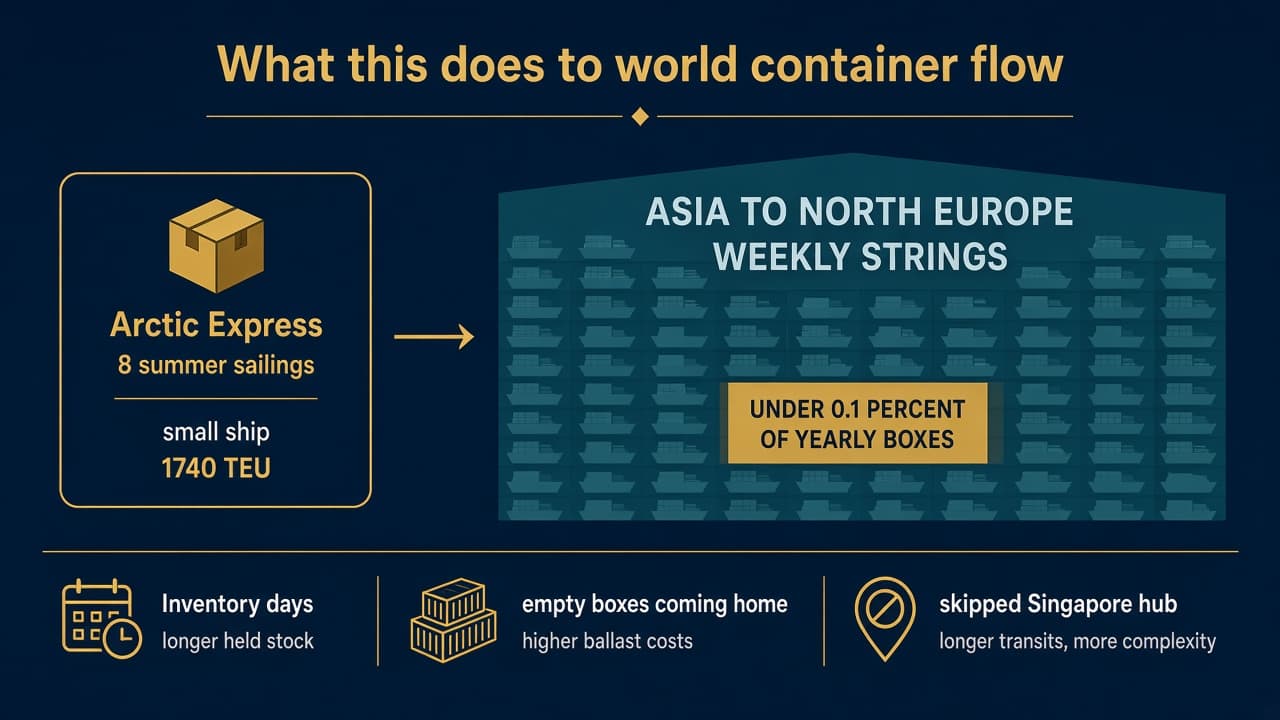
Negative impacts are larger than a press release admits. The route is Russian. EU sanctions list the icebreaker operator. About 95 percent of recent NSR cargo in some tallies has been Russian energy heading to Asia, not Europe-bound boxes. A Chinese liner still needs Moscow's permission. NATO and Arctic states worry about dual-use infrastructure and about a future where the same lane carries more than sneakers. Scale is the other limit. Eight sailings might move on the order of 20,000 TEU in a season, a rounding error next to Asia-Europe weekly strings. Winter still belongs to ice. A late freeze can strand a ship or force a Suez return.
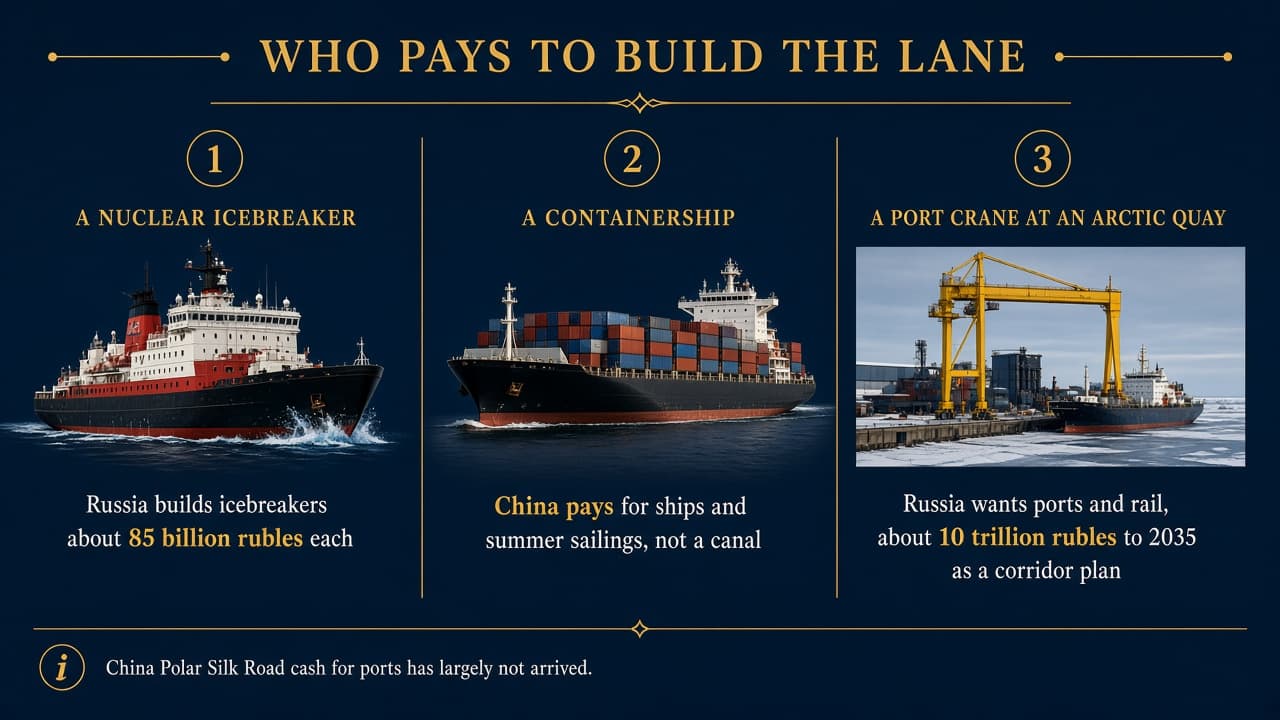
Build cost is the first myth to kill. Nobody is pouring a Chinese canal through the ice. The water is already there. What costs money is the machine that makes the water usable: nuclear icebreakers, ice-class cargo hulls, satellite ice charts, search-and-rescue posts, dredged Arctic ports and the rail that feeds them. Russia, not China, owns that bill. A Project 22220 nuclear icebreaker is now put near 85 billion rubles apiece (on the order of a billion dollars, depending on the ruble). Moscow has been hunting extra-budget cash and state guarantees for the fifth and sixth hulls, Leningrad and Stalingrad. Rosatom has talked of about 10 trillion rubles (about 116 billion dollars) through 2035 for a wider Trans-Arctic Transport Corridor: ports, rail, inland water, icebreakers and an ice-class merchant fleet. A still larger 400 billion dollar wishlist of Arctic projects sits on paper and assumes private and foreign money. CNN and other reporters have noted that the huge Chinese Polar Silk Road cheques for Russian polar ports largely never arrived. China is buying ships, bunkers and a summer timetable. Russia is trying to get someone else to help pay for the ice factory.
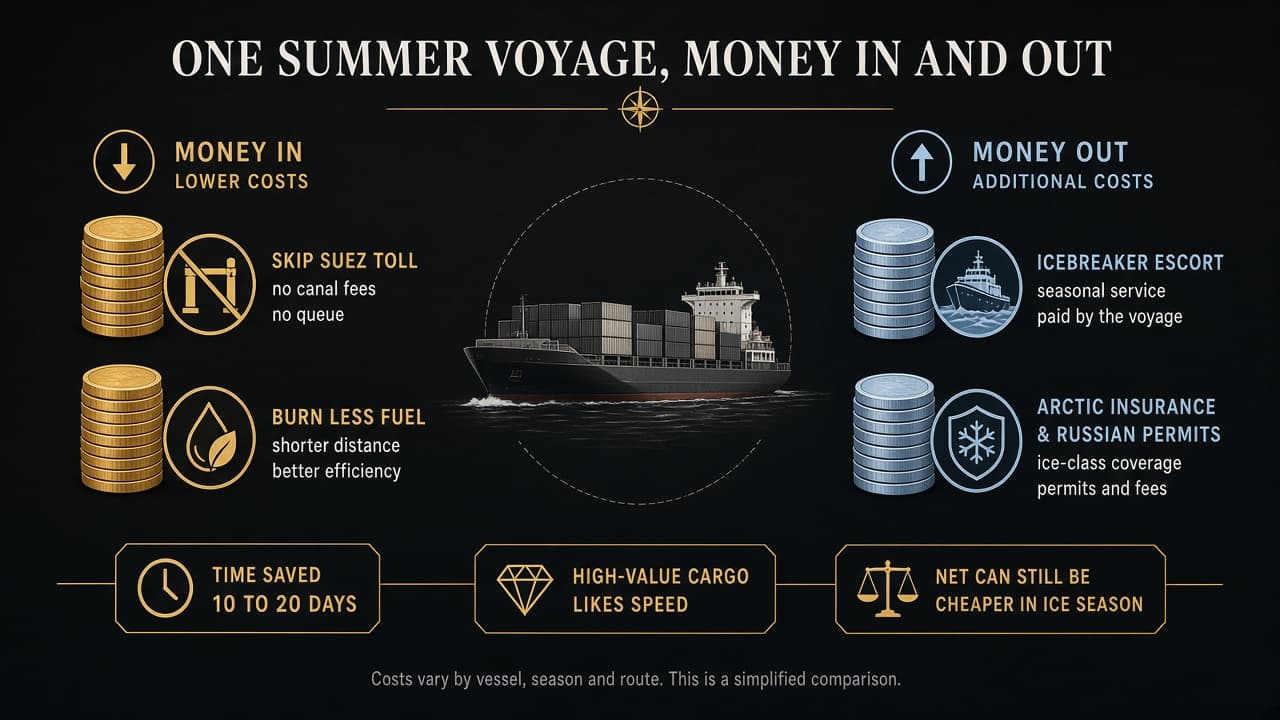
Who pays on each voyage? The shipowner or charterer. In summer the arithmetic can look kind. Skip the Suez Canal and you skip a six-figure toll (trade desks often use about 500,000 dollars as a round number for a large liner, not for a 1,740 TEU feeder). Burn fewer days of bunker. A 2023 peer-reviewed cost study of Arctic versus Suez found total voyage costs about 17 percent lower in July and about 33 percent lower in September for the ship it modelled. That is the good price: fewer miles, fewer days of crew and fuel, sometimes a lower EU carbon bill because the Cape burns more oil. Then the Arctic invoices land. Icebreaker escort, Rosatom permits and ice pilots are commonly put in a band from about 180,000 dollars to 700,000 dollars for a large ship, depending on ice and hours of escort. Arctic hull insurance is often quoted at five to ten times a Suez premium. Current icebreaker tariffs have been described in Russian reporting as below true cost, which is why officials have floated a new NSR cargo fee from 2027 (about 1.50 dollars a tonne, rising toward 2.75, then falling). For a small Chinese boxship stuffed with batteries, time is the product. For a sanctioned LNG tanker, the route is a market. For a bulk carrier of coal, the ice invoice can eat the saving.
Who gets the benefit today is a short list. Chinese exporters of time-sensitive, high-value goods (batteries, solar kit and electronics) get a factory-to-warehouse clock that can beat a Red Sea scare or a Cape slog. Sea Legend and other Chinese operators get a branded Polar product and a way to keep small ships busy. Russia gets transit fees, icebreaker hire, an extra pipe for oil, condensate and LNG toward Asia and a story that the Arctic is still open for business under sanctions. Northern European ports (Teesport, Felixstowe, Rotterdam and Hamburg) get first-call boxes without waiting on the Mediterranean. Shoppers at the end of that chain get the goods a couple of weeks earlier. They do not get a new cheap supermarket. Eight seasonal sailings are a rounding error next to the weekly Suez machine. In 2025 the whole Northern Sea Route moved about 37 million tonnes of cargo. Most of that was Russian Arctic industry, not China-to-Europe boxes. Transit cargo (stuff that only passed through) was about 3.2 million tonnes. The port of Sabetta alone handled the bulk of NSR port turnover. The container story is the headline. The energy story is the tonnage.
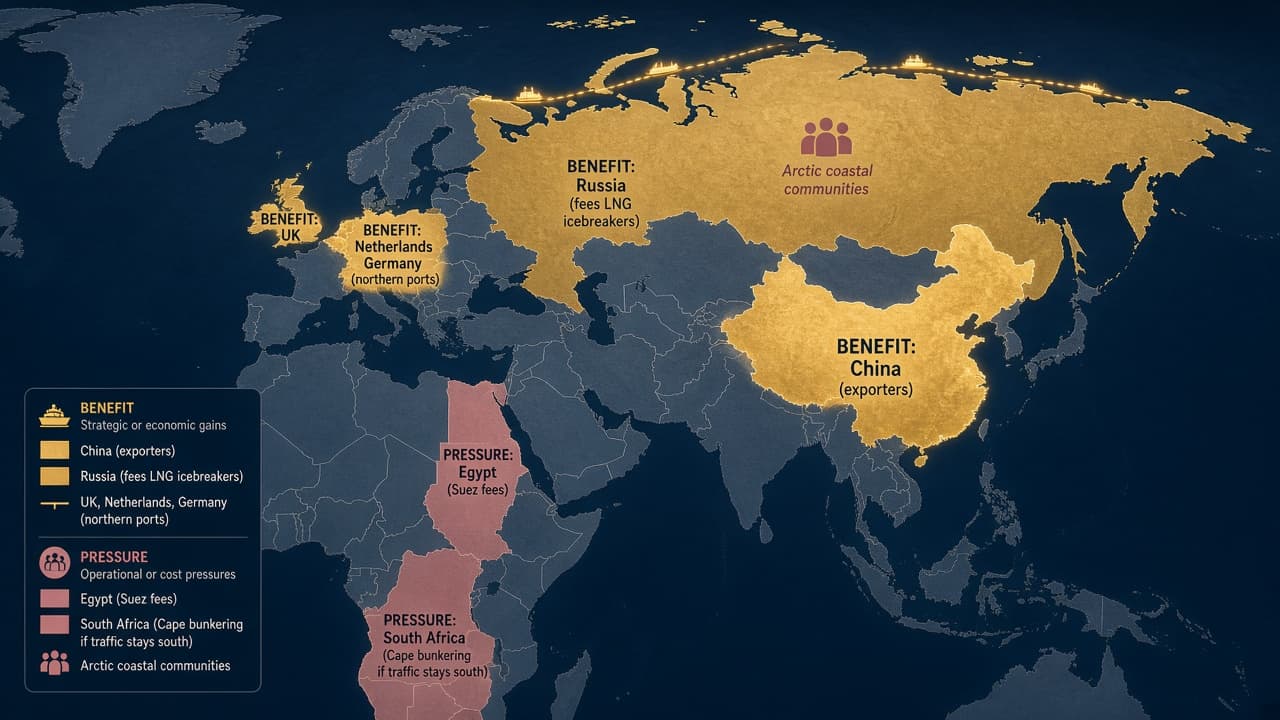
Impacted economies are real even when the tonne count is small. Egypt's Suez Canal Authority lives on transit dues. It will not collapse because of eight Chinese boxships. It will feel a larger bite if Arctic summer strings multiply and if Red Sea risk stays high enough that cargo shops for any other door. South African and West African bunker ports lose calls when ships stop rounding the Cape. India, South Korea and Japan have studied the same shortcut; they gain optionality and they import the same ice and insurance risk. Norway watches more tankers along its coast when Baltic crude sails north to join the NSR. Inuit and other Arctic peoples, plus coastal Russian towns, live with noise, soot, spill risk and a search-and-rescue system that is still thin across more than 5,000 kilometres. The world as a whole gets one genuine public good: a second door when the Red Sea or Suez jams. Diversifying chokepoints is insurance against a single canal holding global shelves hostage. That is the positive case, and it is seasonal, not a new law of geography.
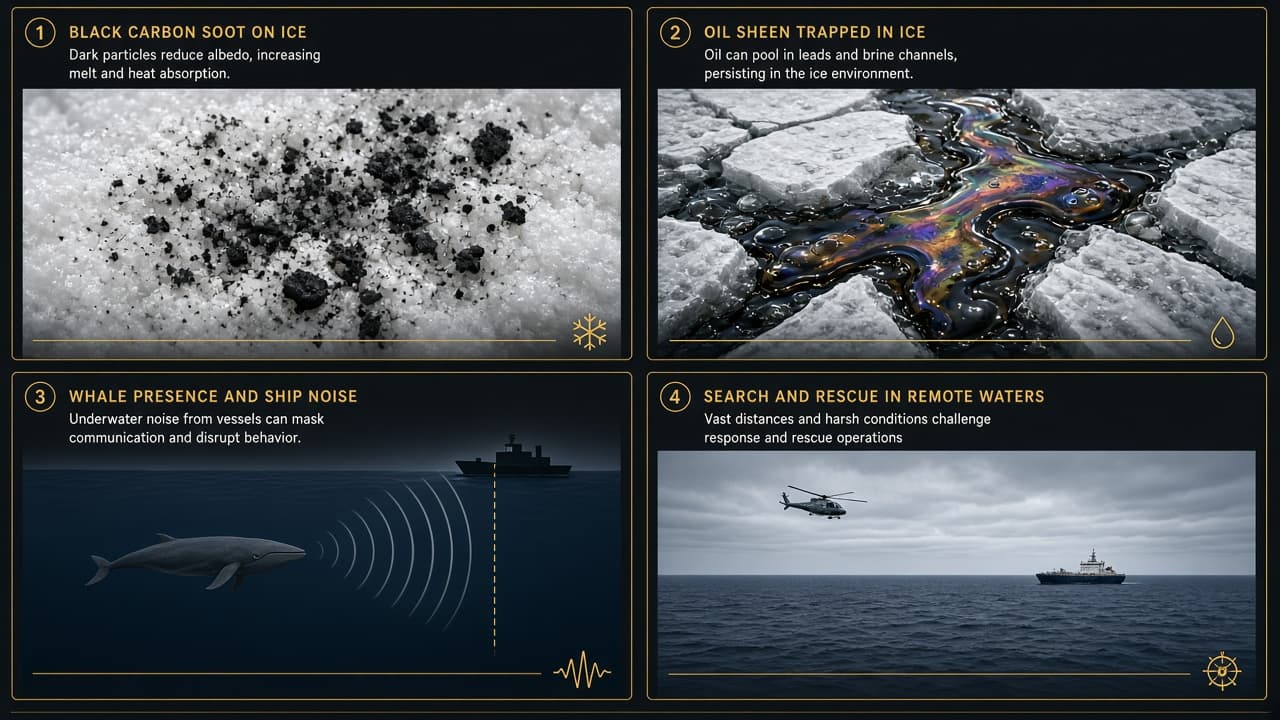
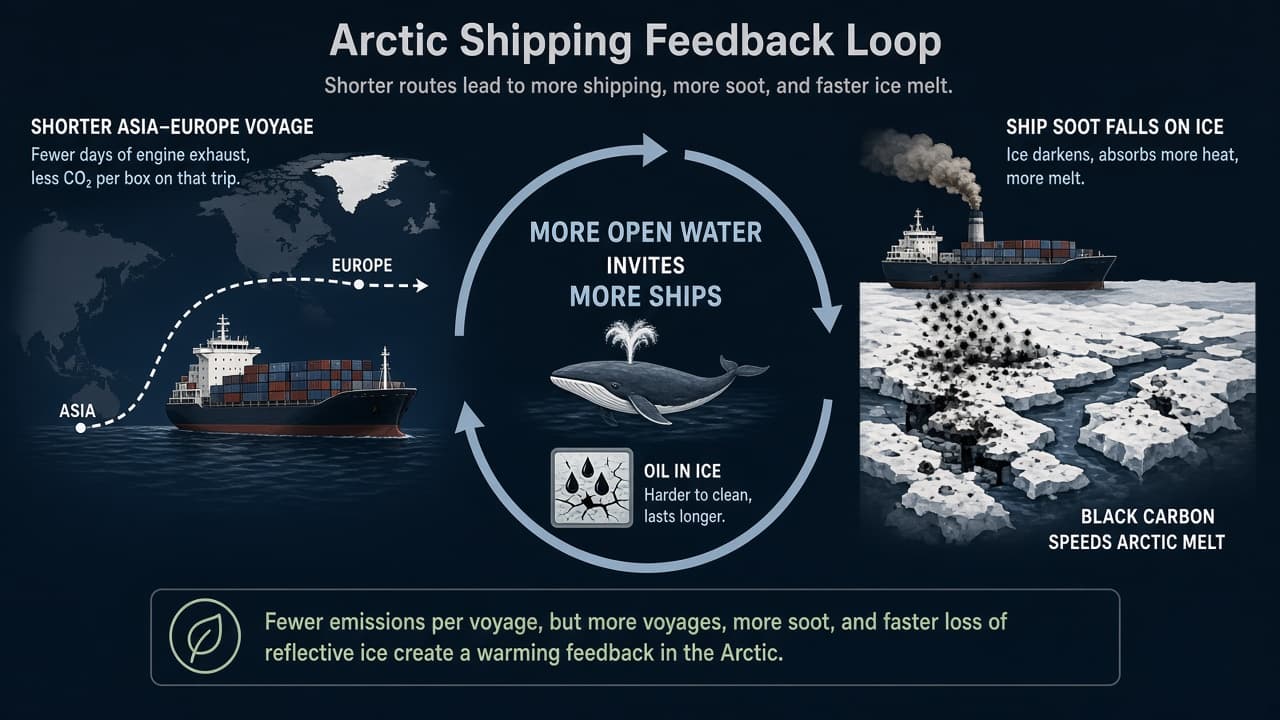
The environment is the bill that compounds. A shorter voyage can cut carbon dioxide per container on that trip. That is real. The Arctic is also where black carbon (soot from exhaust) lands on snow and ice, darkens the surface and speeds melt. The Clean Arctic Alliance reports that black carbon from ships in the IMO Polar Code area almost tripled from 2019 to 2024, from about 259 tonnes to about 759 tonnes. Shipping is a small slice of all Arctic soot and a potent one on white ice. A 2025 Nature Communications warning was that a traffic surge could turn the Arctic into a shipping-emissions hotspot. The IMO has restricted heavy fuel oil in Arctic waters. Russia has not joined that ban, so some of the dirtiest bunker can still burn on the NSR. Oil in ice is a nightmare to lift. Underwater noise and ship strikes hit whales already squeezed by vanishing ice. Shadow-fleet tankers add accident risk. Climate change opened the lane. Using the lane without cleaner fuel can help keep it open by melting more ice, which then invites more ships. That is the long-run trap.
World supply chains do not move on maps. They move on clocks, boxes and warehouses. A global liner network is a set of weekly strings: giant ships, 15,000 to 24,000 TEU, looping Asia through Singapore or Tanjung Pelepas, the Indian Ocean, Suez or the Cape, then Rotterdam, Hamburg, Antwerp and Felixstowe. Those strings are the bloodstream. They carry clothes, toys, car parts and the cheap stuff that fills a supermarket. The Arctic Express is a summer feeder: ships around 1,500 to 4,900 TEU, about eight sailings from mid-August to early October, advertised at about 20 days Ningbo to northern England. Sea Legend also compares that with about 25 days on China-Europe rail and about 40 on a classic Suez ocean string. One weekly Arctic departure is under half a percent of a normal Asia to North Europe container week. The whole eight-sailing season is under 0.1 percent of that trade's yearly boxes. Logistics desks should treat it as a niche product, not as a new trunk.
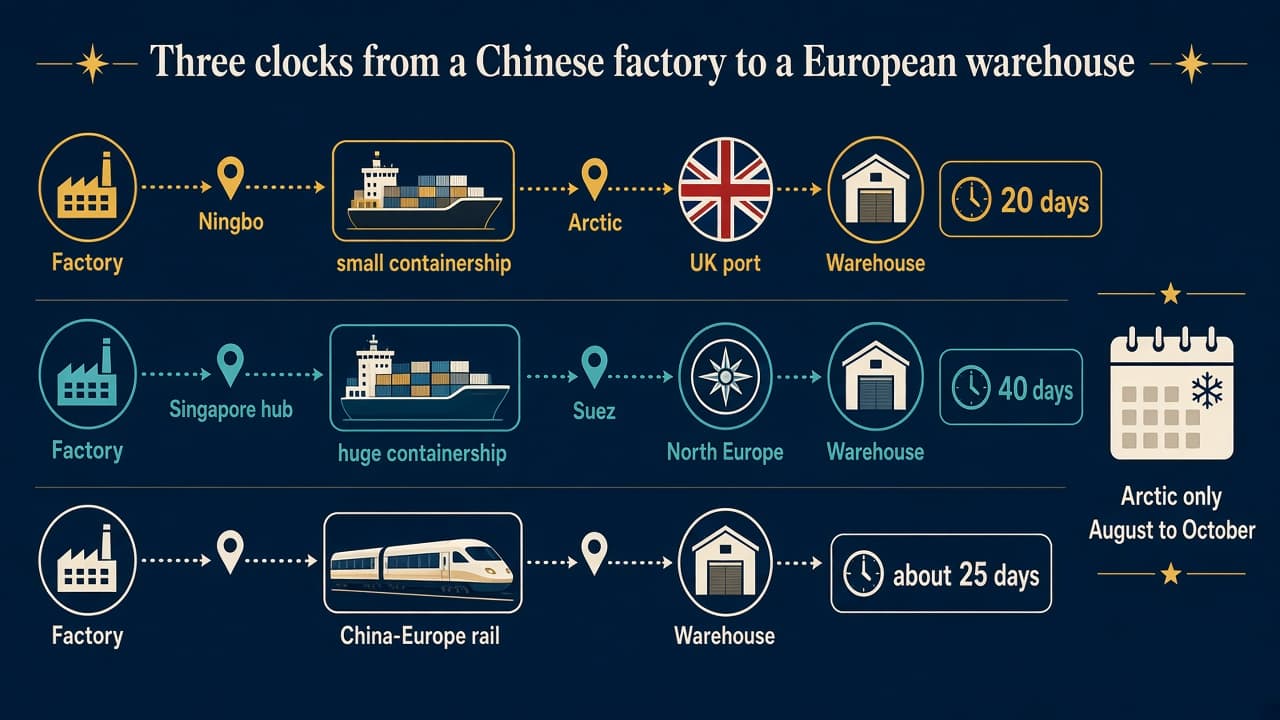
What changes for a shipper is inventory. Every extra day at sea is a day of goods sitting in a steel box instead of on a shelf. Batteries, solar modules and electronics are expensive per cubic metre. Cutting 15 to 20 days versus a Cape diversion frees working capital and reduces the chance that a product misses a launch window. Fashion and toys rarely justify ice insurance. Just-in-time auto plants still need a reliable weekly arrival, not a sailing that ends in October. A planner who books the last Arctic departure on 3 October must already have a November plan on Suez, the Cape or rail. That is the real logistics constraint: seasonality. You cannot build a year-round bill of materials on a three-month door.
Ports and hubs shift with the clock. A Suez string feeds Singapore, Colombo, Piraeus and the Mediterranean. An Arctic string skips those yards. Boxes consolidate in Chinese ports (Ningbo-Zhoushan, Shanghai, Qingdao and others) then land in northern England or the North Sea and move by truck, rail and feeder into the EU. Felixstowe, Teesport, Rotterdam and Hamburg gain a first call. Singapore loses a transshipment move it never really needed for this tiny slice. Empty containers are the hidden cost. Asia-Europe trade is imbalanced: full boxes go west, empties must come home. Some Arctic ships return through the ice. Others go home via Suez or the Cape. That split makes equipment planning harder for a 3PL than a simple weekly loop. Insurance and sanctions screening add paperwork before the box is even gated in.
The positive world-logistics case is diversification. When the Red Sea is unsafe, Suez is blocked or a mega-ship jams a canal, shelves go empty and factories wait. A second ocean door, plus rail, is insurance. It will not stop a global shortage of boxes. It can save a high-value lane for a quarter of the year. The negative case is false comfort: eight sailings cannot replace the alliance networks, the ultra-large hulls or the year-round feeder webs that actually run world trade. If ice, a spill or a permit freeze strands a ship, that cargo is late in a place with thin rescue. Global logistics still lives and dies on Suez, Malacca, Panama and the Cape. The Arctic is a seasonal bypass on the edge of that system.
Eagle Frame's takeaway: China did not invent a canal and it is not writing a cheque for Russia's ice fleet. In 2026 it put a summer container timetable on a Russian sea lane. About 20 days to northern England is a real number against about 40 via Suez, about 25 via rail and about 55 via the Cape, for a handful of ships, with Russian icebreakers, for cargo that can pay for speed. That is a logistics product for batteries and launch dates, not a new bloodstream for world trade. Russia wants the build money. Chinese factories and northern European ports want the days. Egypt wants the canal dues it still mostly keeps. The Arctic wants less soot and a spill plan. Treat the Polar Silk Road as a seasonal bypass and a geopolitical bet, not as the death of Suez and not as a free gift to the climate.