How to calculate percentages
Master three everyday percentage skills: part divided by whole times 100, finding a percent of a number and percent change between two values. Practice with money, grades and simple discounts.
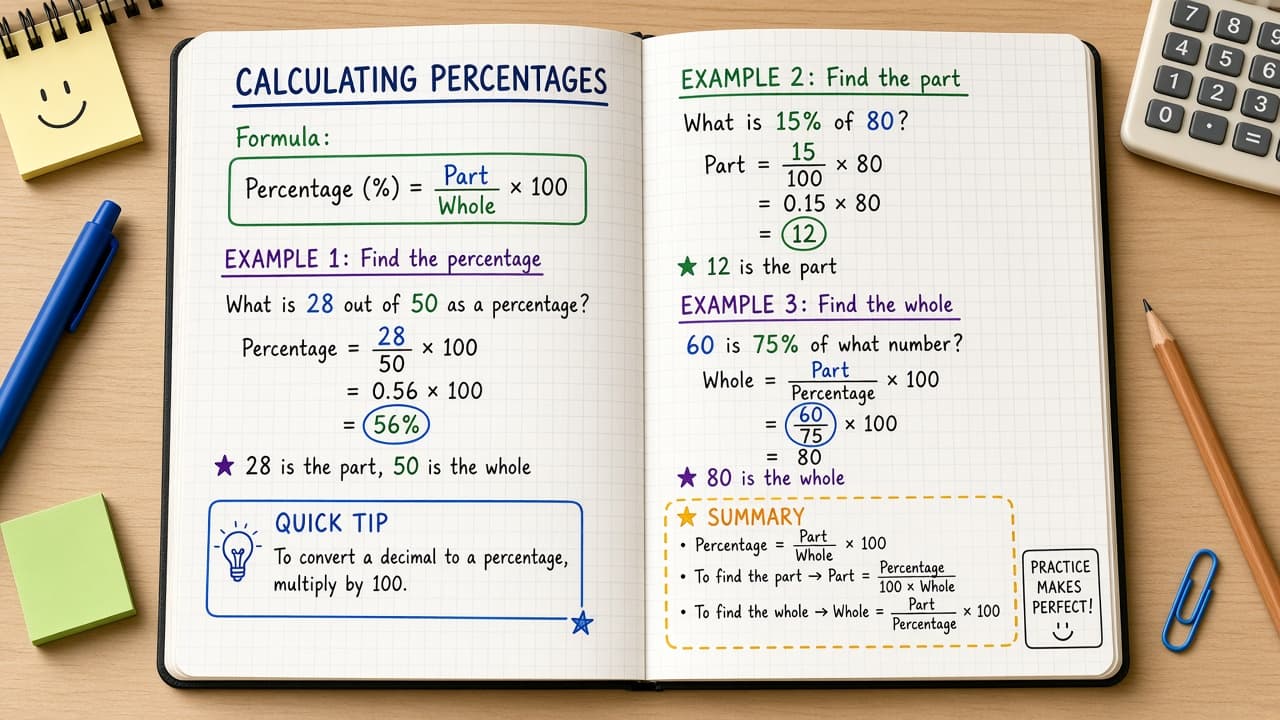
A percentage is a way to talk about a part of a whole using a scale of 100. If 15 out of 50 students finished early, that is 15 ÷ 50 × 100 = 30%. The same idea shows up in discounts, tax estimates, survey results, battery icons and sports shooting percentages.
Three calculations cover most daily needs. First, turn a part and a whole into a percent. Second, find a percent of a number (what is 20% of 80?). Third, measure percent change from an old value to a new one. Learn those three and you can check most claims that wave a % sign at you.
Always ask what the whole is. 20% of a $10 tip base is not the same problem as a score rising 20 percentage points. People mix those up constantly. Write the formula before you hit the calculator so the story stays attached to the numbers.
You can do this on paper, with a phone calculator or in a spreadsheet cell. The math does not change. What changes is whether you remember which number is the part, which is the whole and whether you are describing a level or a change.
Step-by-step guide
Time: 30 to 45 minutes to learn and practice the three core skills
What you need
- Paper and pencil or a notes app
- Basic calculator or phone calculator
- Optional: spreadsheet for checking work
Before you start
- Do not divide by zero. If the old value is 0, percent change is not a meaningful ordinary percentage.
- Separate percent change from percentage-point change. A rate moving from 10% to 12% rose 2 percentage points, which is a 20% relative increase.
Step 01
Turn a part and a whole into a percent
Share problems always follow part ÷ whole × 100.
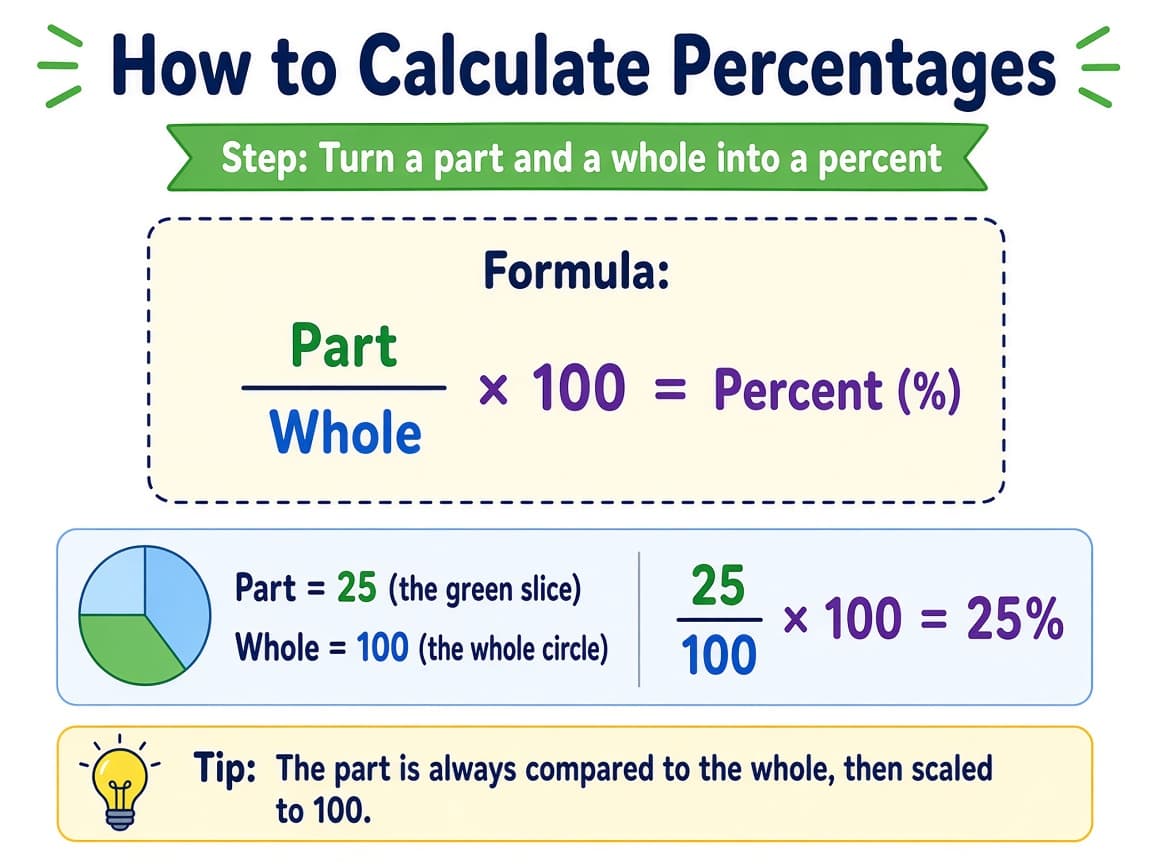
Name the part and the whole first. Then divide and multiply by 100. Do this step in order
1a
Identify the part and the whole
The part is the piece you care about. The whole is the full group or total. Example: 18 correct answers out of 24 questions. Part = 18. Whole = 24.
1b
Divide part by whole
Compute 18 ÷ 24 = 0.75. That decimal is the share on a 0 to 1 scale. Keep extra decimal places if you need a precise percent later.
1c
Multiply by 100 and label
0.75 × 100 = 75%. Write 75% correct, not just 75, so the unit stays clear. Round only at the end unless a rule asks for earlier rounding.
1d
Reject swapping part and whole
Common mistake: dividing the whole by the part and getting a nonsense result over 100% for a simple score. If the part is smaller than the whole, the percent should usually sit under 100% for share problems.
Step 02
Find a percent of a number
Convert the percent to a decimal, then multiply by the amount.
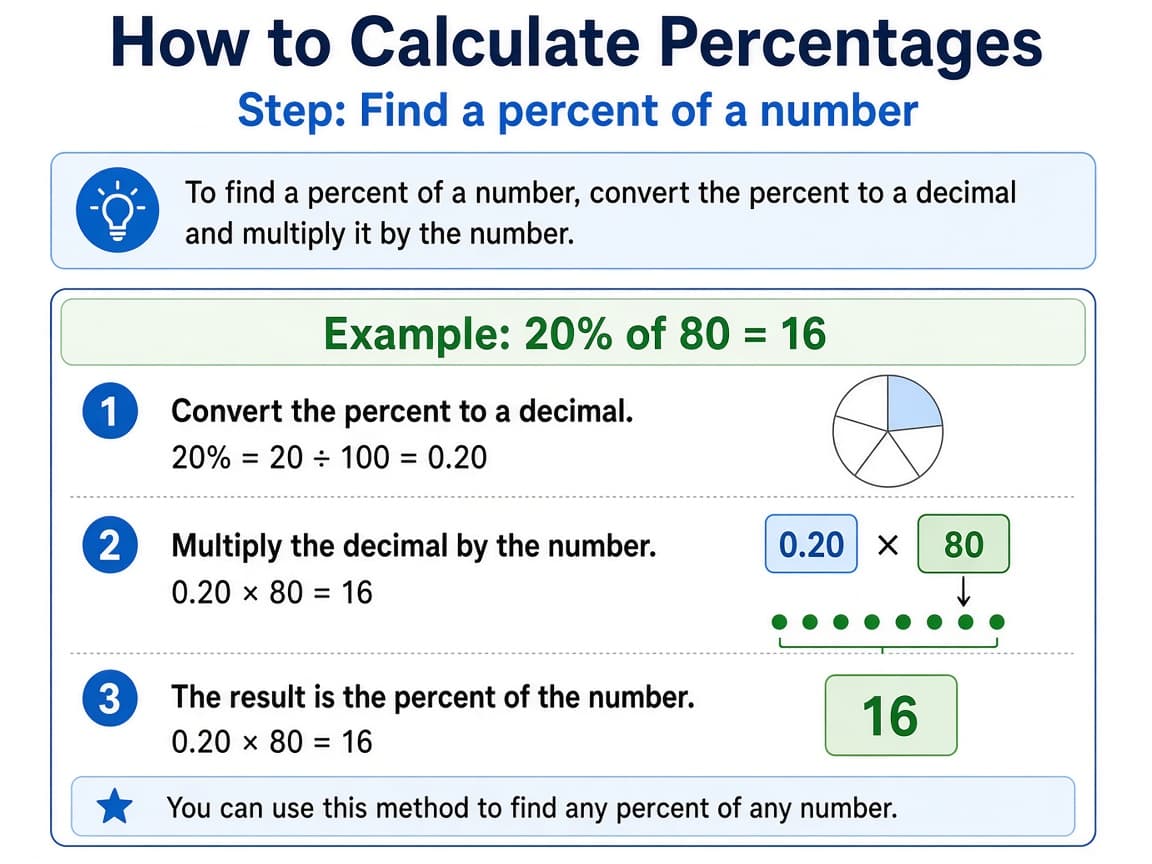
20% of 80 means 0.20 × 80 = 16. Same idea for tips, discounts and tax estimates. Do this step in order
2a
Convert the percent to a decimal
Divide by 100 or move the decimal two places left. 20% becomes 0.20. 7.5% becomes 0.075. 150% becomes 1.5.
2b
Multiply by the base amount
For 20% of 80, compute 0.20 × 80 = 16. For a 15% tip on $42, compute 0.15 × 42 = 6.30.
2c
Optional shortcut: percent ÷ 100 × amount in one line
On a calculator you can enter 20 ÷ 100 × 80. In a spreadsheet use =0.2*80 or =20%*80 depending on the app. Pick one method and stay consistent while you learn.
2d
Do not add the percent as if it were already money
Common mistake: treating 20% of 80 as 80 − 20 = 60 because the % sign was ignored. Twenty percent points and twenty dollars are different units.
Step 03
Calculate percent change
Percent change asks how much a value moved relative to where it started.
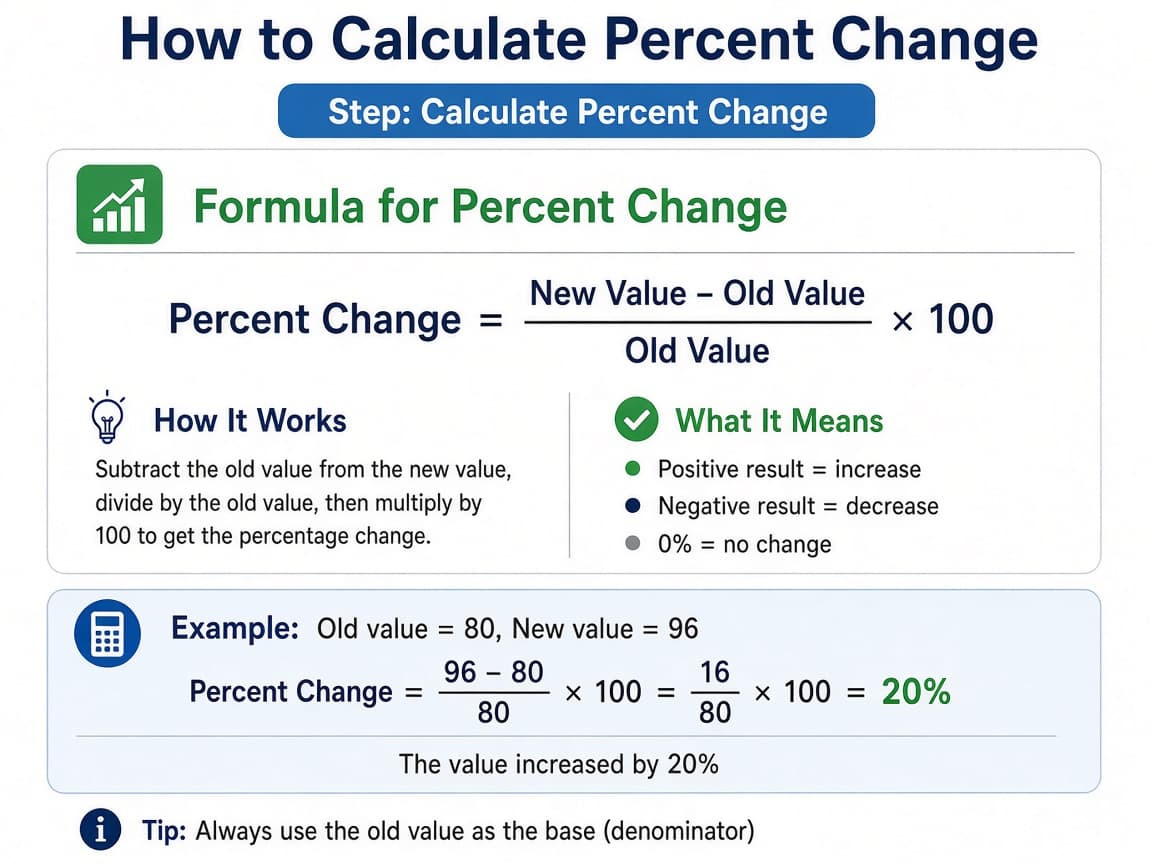
Percent change = (new − old) ÷ old × 100. Positive means up. Negative means down. Do this step in order
3a
Write the old and new values
Example: a price moves from $40 to $50. Old = 40. New = 50. Another example: followers fall from 1,000 to 800.
3b
Subtract, divide by the old value, multiply by 100
($50 − $40) ÷ $40 × 100 = 25% increase. For 1,000 to 800: (800 − 1,000) ÷ 1,000 × 100 = −20% change (a 20% decrease).
3c
Say increase or decrease in plain words
A negative result is a decrease. You can report −20% or a 20% decrease. Be consistent in a report so readers are not guessing the sign.
3d
Do not divide by the new value
Common mistake: using (new − old) ÷ new. That is a different statistic. Standard percent change uses the old value in the denominator.
Step 04
Check real examples and common mix-ups
Practice on discounts, grades and newsy claims so the formulas stick.
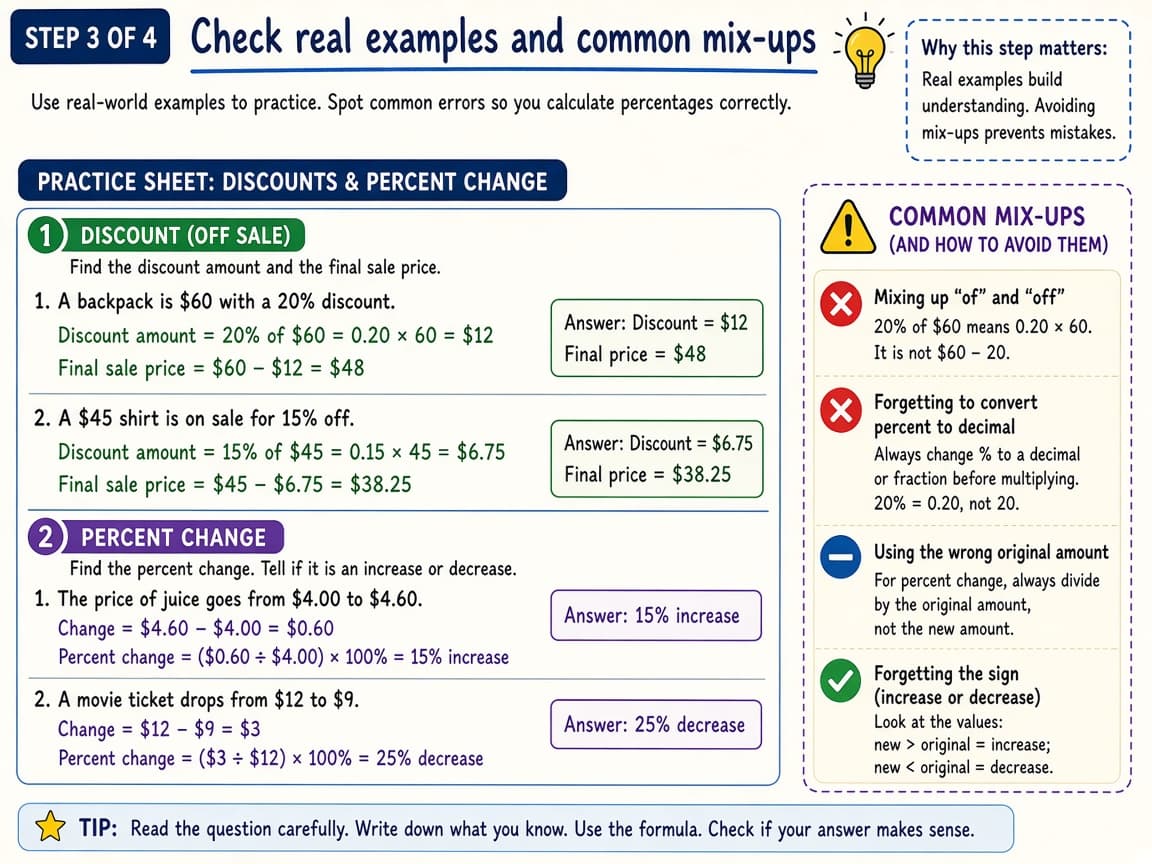
Work a discount, a quiz score and a before-after change. Then explain each answer in one sentence. Do this step in order
4a
Practice a discount then a final price
A $80 jacket at 25% off: 0.25 × 80 = $20 off, so you pay $60. Check by 80 × (1 − 0.25) = 60. Both paths should match.
4b
Separate percentage points from percent change
If support rises from 40% to 44%, that is up 4 percentage points. Relative change is (44 − 40) ÷ 40 × 100 = 10%. News headlines sometimes blur these on purpose.
4c
Estimate to catch calculator typos
Before you accept 312%, ask whether that size makes sense. Rough estimates catch missed decimals and swapped inputs fast.
4d
Reject stacking percents without care
Common mistake: taking 10% off twice and calling it 20% off. Two sequential 10% discounts leave 0.9 × 0.9 = 0.81, which is 19% off, not 20%.
Done when
- Part and whole identified for share problems
- Percent-of problem solved with decimal or ÷100 method
- Percent change uses (new − old) ÷ old
- Answer labeled with % and the context
Eagle Frame's takeaway: percentages get easy when you name the whole first. Use part ÷ whole × 100 for a share, multiply for a percent of a number and (new − old) ÷ old × 100 for change. Label the answer so you never confuse a 20% discount with a jump of 20 percentage points.